Read this post on Josh’s Substack: Powering Spaceship Earth.
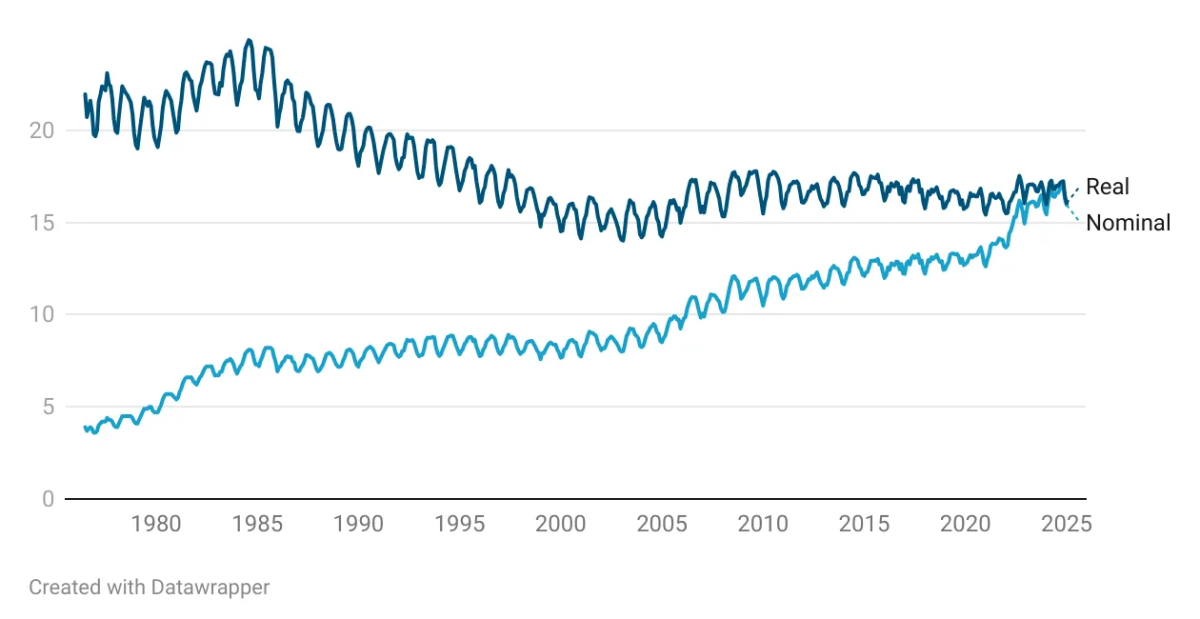
A key fact about electricity prices is that, adjusting for inflation, today’s national average prices are roughly the same as they were in the 1990s. That hides a lot of variation that happens in regions and states.
As shown below, the Pacific, New England, and the Pacific Noncontiguous regions of the US pay dearly for electricity. The national average is about 15-17 cents. That’s half of the cost of places like Hawaii, California, and Alaska. And a third less than places like Vermont and New Hampshire (both around 20-23 cents). These are all residential prices.
Why the differences? A major contributor is geography. If you’re in the middle of the ocean, you have fewer options. Hawaii pays more, and that is reflected in the noncontiguous Pacific line above. Set geography aside, it’s largely out of our control.
What the New England and Pacific lines should convince you of is that policy matters. In New England, the primary issue is that the states routinely block pipelines and transmission lines, thereby generally preventing development. That leaves them with high prices. In the case of the Pacific, there is a similar anti-development impulse. But it’s impossible to ignore the ways that several of those states have pursued aggressive climate policy, too.
People often look at this and become discouraged. My pitch is the opposite. Unlike geography, we get to set policy. This means there is ample room to make electricity both abundant and affordable.
You can read more here, but I snuck Texas in as its own region in the graphic above for a reason:
Has electricity gotten more expensive?