Read this post on John’s Substack: Creative Frontiers.

Hollywood Sounds the Alarm
Enough was enough. The nation had to be warned of the danger crouching at its doorstep.
It was 1982 and a few of Hollywood’s finest, including Clint Eastwood, appeared before a congressional subcommittee. They had come to warn of a new technology that, as one explained, posed as great a threat to the American public “as the Boston strangler is to the woman home alone.”
It was a “great tidal wave” that would crash on the American film industry, causing it to “bleed and bleed and hemorrhage.”
What could possibly wreak such havoc? Jack Valenti, president of the Motion Picture Association of America explained, it was “the video cassette recorder and its necessary companion called the blank tape.”
As he shared stats on the growing popularity among families to record television shows and then skip the commercials, he noted in passing that his family had their own collection of tapes.
Representative Kastenmeier interrupted, “Do you consider yourself and your family infringers when you engage in that practice?”
Valenti dodged the question, explaining that the studios did not intend to prosecute consumers for recording at home.
Kastenmeier interrupted again, “That wasn’t my question.”
Yes, Valenti confessed, “I am taking somebody else’s copyrighted material without their consent and I know damn well I am infringing.”
The very technology that Valenti feared, he already found irresistible.
A Very Happy Birthday
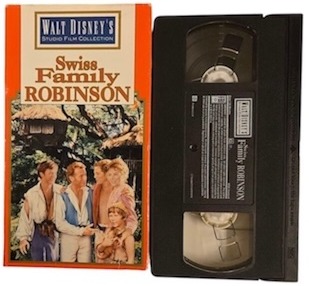
Like Valenti’s family, I also found this technology irresistible. I still remember my seventh birthday party, also in 1982. My mom rented a VCR and a cassette of Disney’s Swiss Family Robinson. It was earth-shattering. I could watch the movie that I chose, whenever I wanted, and as many times as I wanted… until we had to return the VCR the next day.
Today, with the near-infinite control over programming that we have, it seems absurd that I was so elated over such little choice. But at the time, the broadcasters were in charge, not the audience. The VCR flipped the script a bit, and I loved it.
Hollywood… did not love it as much.
As Valenti explained, the average cost to make a film was $20 million and eight out of ten movies did not recoup the costs in theaters. This was a risky business and the VCR threatened to erode the aftermarket sales and licensing revenues. It also could eliminate the value in running commercials if viewers could just skip them.
Valenti’s solution was for Congress to recognize the rights of the “creative property owners” and provide the studios a portion of the royalties from the sales of VCRs and blank tapes. Consumers could enjoy this new found freedom and copyright holders could be compensated.
Hollywood vs. Sony
Valenti was not the first to defend the film industry against this new threat. A few years before, in 1976, Universal City Studios and Walt Disney Productions sued Sony, the manufacturer of the Betamax videocassette recorder. They argued that Sony produced a technology used to reproduce their copyrighted material without permission.
The case eventually landed in the U.S. Supreme Court in 1984, and Sony won, on a 5-4 decision. The reasons boiled down to the idea that a manufacturer of a technology with substantial legitimate uses shouldn’t automatically be punished because someone uses it unlawfully. And, recording a program to watch it later was just “time-shifting,” which qualified as “fair use.”
In addition, the majority opinion noted that there wasn’t sufficient evidence of market harm and that there could actually be a silver lining. More people might watch a broadcast because now they could record it to watch later, which could increase the value of the rerun rights.
Meanwhile, as the judges deliberated in the court, entrepreneurs were experimenting in the market.
The Rise of the Video Stores
The same year that Universal and Disney sued Sony, Andre Blay, a servicer of video equipment in Michigan, had an idea. He reached out to studios inquiring about selling their movies on videocassettes. An executive at Fox, Steven Roberts, was intrigued by the idea and made a deal.
Blay launched the Video Club of America to sell the tapes, which he hadn’t produced yet, and 9,000 people joined. Consumers were eager to own their favorite films, one veterinarian from North Carolina called immediately, provided his credit card information, and ordered all 50 titles at $50 each. Blay was on to something.
His partnership with Fox caught the attention of another entrepreneur, George Atkinson. He was struggling with a small business renting out super 8 projectors and screens for home parties. If people would rent a projector, perhaps they would rent a cassette tape, he thought. Others disagreed, noting “that Americans are not a renting public…” Atkinson would prove them wrong.
He purchased one Beta and one VHS copy of the 50 titles available. Then he opened a video-rental business in Los Angeles in 1977. Now, movie lovers could join his rental club and take home a movie they wanted at a fraction of the cost to own it. And they did.
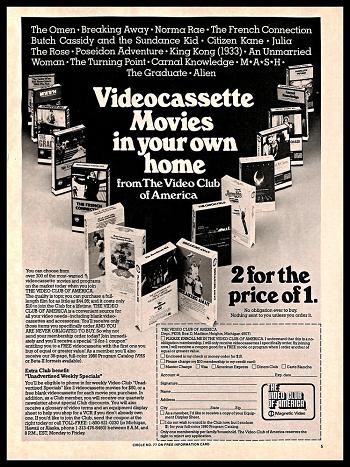
Over the next year, the price of a VCR dropped below $1,000 and by the end of 1978 Blay’s company, Magnetic Video, had sold a quarter of a million cassettes and Atkinson was franchising rental stores across the country.
But this new business model troubled Valenti and the studios. Under the “first-sale doctrine,” a store could purchase a cassette once and rent it hundreds of times without paying the copyright owner another dime. The rentals were perfectly legal, but Hollywood wanted a share of the growing business. It was one more reason Valenti turned to Congress in 1982, warning that the VCR threatened the future of American filmmaking.
The Displacive Fallacy
Three years after Valenti’s testimony, Hollywood was back in Washington D.C., not to control the VCR market, but to wine and dine it.
Disney and Paramount hosted lavish lunches and concerts for some 6,000 video dealers. And with good reason. In 1985, consumer spending on videocassette sales and rentals was approaching theatrical box office receipts, around $3.5 billion. The VCR had created an enormous new business, and movie theaters weren’t going anywhere.
By 1987, even Valenti had changed his tune. Speaking to the Video Software Dealers Association, he acknowledged “once we were adversaries, now we are not.”
What had Hollywood missed?
Daniel Boorstin, then Librarian of Congress, had a name for it: the “displacive fallacy.” We tend to assume that each new technology will replace the old. Television will replace books, video will kill the radio star. But technological change isn’t necessarily a zero-sum contest. New technologies can create new opportunities for the old.
Hollywood wasn’t wrong to worry about copyright infringement or the erosion of its existing business. But its focus on what it might lose made it harder to appreciate what consumers and entrepreneurs might create.
For Valenti, the VCR threatened Hollywood’s control over its movies. For a seven-year-old boy, it meant getting to watch a movie he chose at his birthday party. For George Atkinson, it was an opportunity to build a business around that newfound freedom.
The VCR gave audiences more control, entrepreneurs new opportunities, and Hollywood an entirely new market. It turns out the VCR wasn’t a strangler after all. It was quite the opposite.