Originally published in Econosseur.
Those who do not engage in the traditional arts might be wary of calling themselves artists. They might perceive creativity as something extraordinary or beyond their capabilities. A calling for the special few who are born with these gifts.
Fortunately, this is not the case.
Creativity is not a rare ability. It is not difficult to access. Creativity is a fundamental aspect of being human. It’s our birthright. And it’s for all of us.
Creativity doesn’t exclusively relate to making art. We all engage in this act on a daily basis.
To create is to bring something into existence that wasn’t there before. It could be a conversation, the solution to a problem, a note to a friend, the rearrangement of furniture in a room, a new route home to avoid a traffic jam.
What you make doesn’t have to be witnessed, recorded, sold, or encased in glass for it to be a work of art. Through the ordinary state of being, we’re already creators in the most profound way, creating our experience of reality and composing the world we perceive. (Rick Rubin, The Creative Act: A Way of Being, 2023, pp. 1-2)1
This is my first time writing anything on the combination of music and economics, despite both of these areas representing the majority of my daily time. Music has always been a love and leisure of mine. And economics is my profession, which also is something I love and think about when I am relaxing. But I have never formally combined the two… until last week.
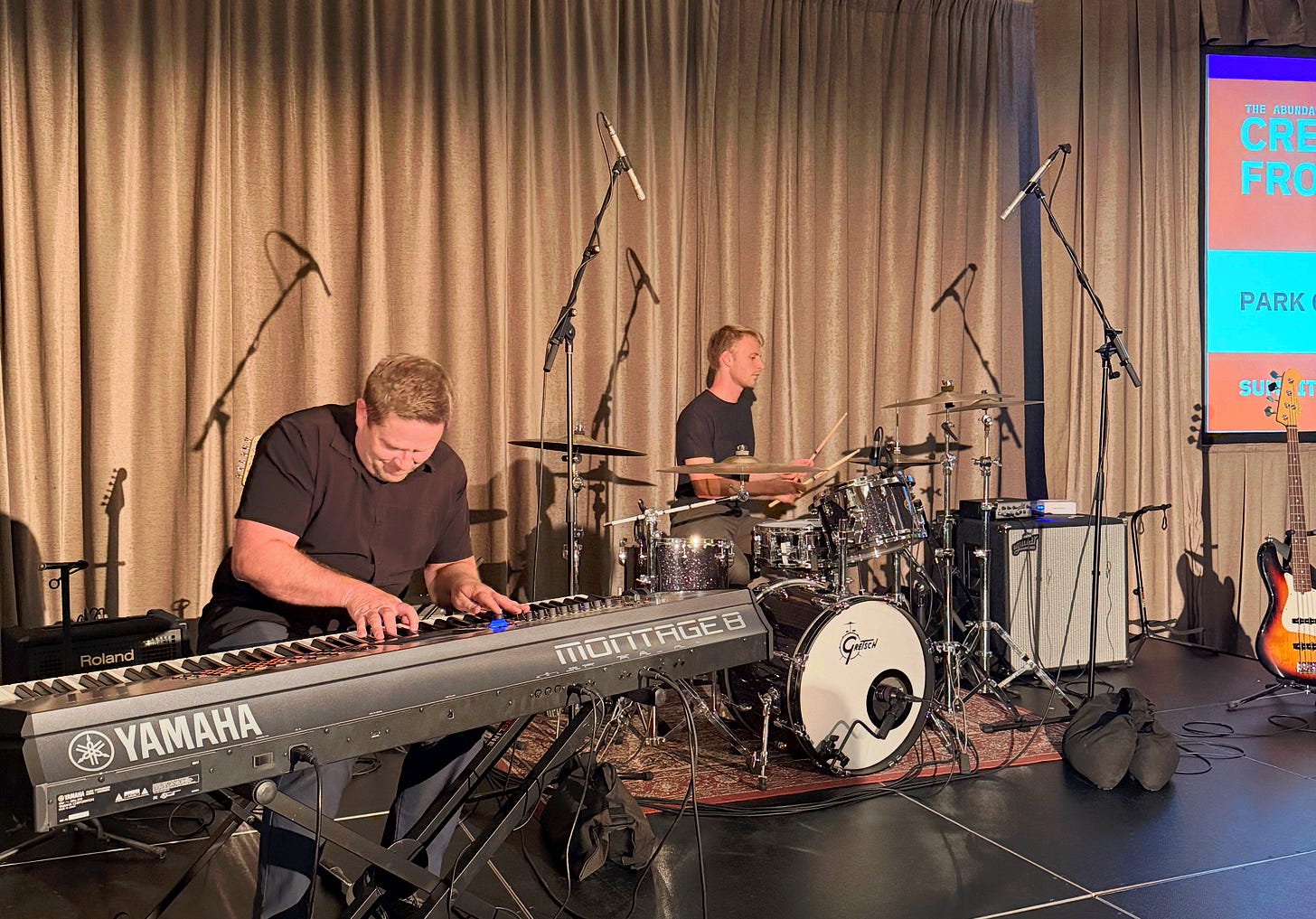
I spent the first half of last week at the Abundance Institute’s Creative Frontiers Summit in Deer Valley, Utah, hosted by my colleagues John Hardin and Kayla Harris. The Summit program focused on the music industry, incentives, and hurdles for musicians, new music technologies, and AI. (John Hardin also curates the Creative Frontiers Substack, commenting at the crossroads of innovation, culture, and art.)
I remember when the Abundance Institute ran its inaugural Creative Frontiers program in 2024, with me thinking, “Why is my energy-tech-AI-focused policy organization running a music workshop?” But since that initial presumption, I have realized that the Abundance Institute was ahead of the curve. The three most influential cultural media today are probably music, movies, and social media. And questions about AI, technology, and regulation abound in all three. The Abundance Institute was ahead of the curve to recognize that the music industry was a key cultural and policy touchstone for how we incorporate AI productively into our lives.
It was a refreshing change of perspective and insights to spend two days last week talking, eating, and jamming with some of the coolest musicians and creators.
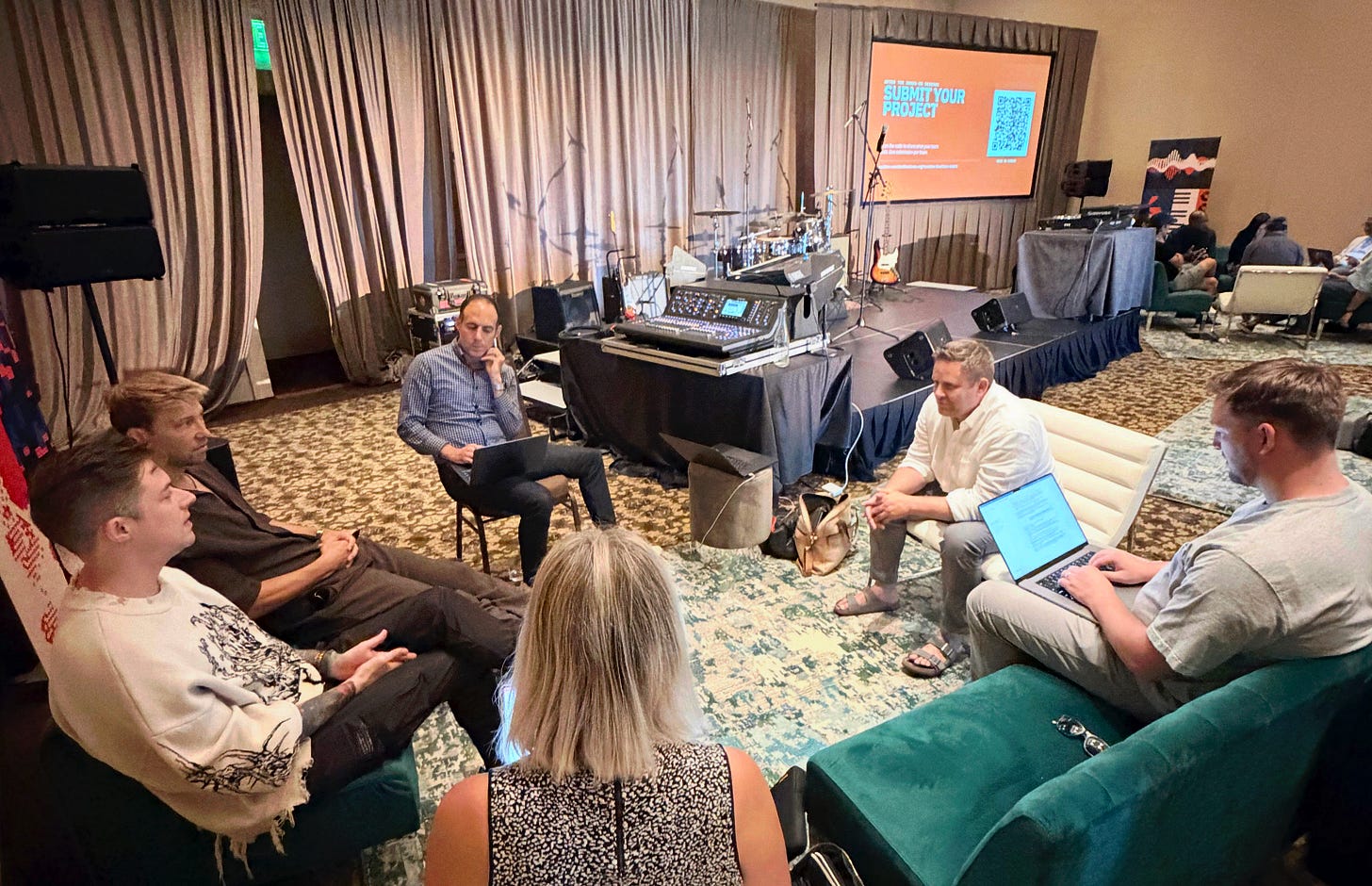
The following is a summary of five of the main economic and policy insights I learned spending two days talking about music, technology, regulation, and AI with these musicians and creators.
- Make music that people like, and the algorithms become secondary
- Attribution and copyright laws govern who gets paid and how
- Music compensation has changed since the 1950s and influenced what music gets made
- All creative output is based on training on previous work
- Measure the health of the music industry with dollars and entrants
1. Make music that people like, and the algorithms become secondary
I have heard recent experts across platforms lament how important the algorithms are at driving traffic and consumption. But I am convinced that artists and service providers should spend most of their effort on the quality and consistency of their content, and then spend a left-over smaller amount of effort on marketing and algorithm maximization. The following three recent stories showcase the importance of platforms and algorithms. But they also beg a question of whether a better outcome could be realized with better content.
- On July 16, Jon Lewis of SportsMediaWatch.com analyzed the ratings trend after Major League Baseball debuted its Home Run Derby portion of the All Star events on Netflix. He noted the viewership was down 8% from the 2025 event numbers on ESPN, which represented the lowest TV audience for the event since 2003. He proposes that much of the decline in viewership came from switching platforms from the more traditionally accessed ESPN cable network to the Netflix streaming platform. However, I think it is likely that many more people would watch baseball’s home run derby if they were more focused on the content.Netflix had over 325 million paid subscriptions as of the end of 2025.2 The highest viewership years for the MLB Home Run Derby came in 1998 and 2008, each year with approximately 9.2 million viewers. The 1998 Derby was at the height of the McGwire-Sosa home run record chase, with Ken Griffey, Jr. also participating. And the 2008 Derby was the final one at the original Yankee Stadium, the same stadium where Babe Ruth, Lou Gehrig, Joe DiMaggio, Mickey Mantle, and Yogi Berra hit home runs. Only four of the top-10 home run hitters participated in the 2026 Home Run Derby, with the most popular player, Shohei Ohtani, notably missing.3
- Olivier Blanchard is the rare combination of a very good economist with a long and renown career in both academia and policy who also has a relatively active and insightful X account.4 He had an interesting post on July 17 noting that he was happy his X account had just passed 300,000 followers. But he noticed something strange. The algorithm can greatly influence the number of followers of an account by a factor of 20, even if there is no change in the quality or frequency of the posts.
- “…But there is something interesting and worrisome here. Since March, I have seen the number of new followers per day being about 20 times what it was earlier. It is not because I had great tweets; I had fewer than usual. It is not because of bots: most new followers seem legit. It seems that it is due to a change in the X algorithm, which puts more weight on tweets which appear to trigger good discussions (I do not know the exact criteria). Now, obviously, I am delighted by the change. But the scary part is how an algorithm, depending on what it wants to promote, can multiply (and presumably divide…) visibility by a factor of 20.” (Olivier Blanchard, X post, Jul. 17, 2026)
- YouTube music commentator Rick Beato posted an interesting video on July 17, entitled, “Why Paul McCartney Won’t Be On My Channel”. In this post, he quotes Bob Lefsetz, the author of a long-running online music newsletter speaking about the marketing of the Rolling Stones’ new album, Foreign Tongues, who said the following about Beato’s channel:
- “The biggest mistake the Stones made was not going on Rick Beato’s show. Beato is not subject to the algorithm, his fans are dedicated. They tune in just for him. And Beato specializes in the music itself, how it was created. That’s the kind of information that needs to be spread if you want people to actually stream a song. Go DEEPER! (Bob Lefsetz, “The Stones’ New Album,” Jul. 12, 2026).”
- My conclusion is that the necessary condition for consistent attention seems to be consistent, focused, quality content. The various objectives and algorithms for the media platforms are a significant set of incentives for marketing to navigate. But the primary focus of the artist should be on the content first, then then marketing.
In contrast to focusing on algorithms over content, I proposed the following maxim to a number of participants at the Creative Frontiers Summit. And they all gave me an energetic agreement. This maxim was first posed to me at the Summit for case of musicians by my brother, Romney Evans, who is a tech founder and CMO of True Fit, and who has also been in a band, produced an album, and used Suno to create a working example of a title piece of music for a forthcoming movie. I asked the attendees to tell me if they thought the following was true:
The hardest job for an artist is to create a work that other people love. (Romney Evans, Jul. 14, 2026)
One attendee who produces music and provides touring services to bands grabbed my shoulder, looked me in the eyes, and said, “Yes, that is the only thing.” The point is to create algorithm-proof or algorithm-independent content that people are willing to come and get, wherever it is available. Only after that, the marketing job is to make the product as available as possible.
Rick Rubin’s order of priorities for creating great music surprisingly places the audience last.
In terms of priority, inspiration comes first. You come next. The audience comes last. (Rick Rubin, The Creative Act: A Way of Being, 2023, p. 130)
In a similar vein, Steve Jobs famously focused on producing products that he and his friends would want to use as a winning strategy for gaining customers and marketshare in business.
…every good product that I’ve ever seen… is because a group of people cared deeply about making something wonderful that they and their friends wanted…. That’s how almost everything I know that’s good has come about. It didn’t come about because people were trembling in the corner worried about some big company stomping on them. Because if a big company made the product that was right, then most of these things wouldn’t have happened…. (Steve Jobs, Fireside Chat Q&A Session, Apple WWDC, 1997)
I think the focus of the artist, as well as anyone who wants to make a living producing services (myself included with my economics output), should be to put most of his focus on trying to make a product that he loves and that he thinks other people will love. Then use the media and information platforms as effectively as possible to market the work. And lastly let the market speak. Because it is so hard to predict what the market would want, the most successful creators in the business recommend focusing on what you would want yourself.
If content quality and consistency are the primary focus of creators, the roles of marketing, algorithms, platform, and AI’s contribution become secondary. Creators focusing on quality make consumers focus on the product quality, regardless of the tools a creator uses.
2. Attribution and copyright laws govern who gets paid and how
Attribution, copyright, and the institutions and conventions that ensure the creator of a product owns that product and is paid for that product represented a large part of the discussions at the Abundance Institute Creative Frontiers Summit. Of particular interest was the relationship and liability among AI models that were trained on previous works, the creators of those previous works on which the models were trained, the owners of the AI models, the output from the AI models, and the AI users who prompted the models to create the output.
2.1. Current US copyright law
Current copyright law in the United States says that AI-assisted works can receive copyright protection when there is sufficient human creative contribution, while purely AI-generated expressive material is not copyrightable.5 However, there is still debate about what constitutes a human contribution. The current question to answer to determine the legal threshold is “Did a human determine the expressive elements of the work?” Table 1 below shows the US Copyright Office’s positions summarized as a spectrum.6
One of the current debates is whether elaborate AI prompts and human iteration with an AI should represent a copyrightable human contribution. Table 1 shows that this case would likely not be copyritable under current law. However, one can make a strong case that the iterative process with an AI is analogous and similar to the iterative process of recording takes in the studio.
2.2. Sampling rules, drum discrimination, and AI
On the first night of the Creative Frontiers Summit, a dinner panel discussion was held that included John Hardin and Virginia Postrel of the Abundance Institute, Charles C. Mann of The Atlantic Monthly, and music producer Om’Mas Keith. and Discussion of the dinner panel discussion with Om’Mas about sampling law and how it changed music, copyright, and attribution.
Music sampling, the practice of taking segments of sound from another artists work and including it in your work, has gone through four distinct eras: (i) 1970s to mid-1980s, sampling emerges from DJs extending jams from funk, soul, and disco records, (ii) mid-1980s to 1991, affordable sampling technology gives rise to massive use in hip-hop with loose licensing requirements, (iii) 1991 to mid-1990s, Grand v. Warner legal decision requires artists to license samples, and (iv) 2000s to present, modern licensing era in which any digital sample or likeness must be licensed.7 Similar to the line between AI output copyrightability and non-copyrightability from Table 1, sampling law is also an area of active policy debate regarding how similar a current work can be to a previous work and not require licensing.
The introduction of AI into music generation is the most recent augmentation of the sampling debate. Many musicians and producers can now use products like Suno, Udio, and Splice to generate sounds “in the style of” published music on which their AI models have trained, separate stems from recordings, recreate vintage instruments, and imitate production techniques without copying the original recording.
An example of some of the contradictions that exist in musical purism arguments include those who detest AutoTuned vocals, the technology that digitally adjusts the tone of a vocal to an exact pitch.8 One of the attendees at the Creative Frontiers Summit highlighted the hypocrisy of objectively opposing AutoTuned vocals on the basis of artificial musical production saying the following.
If you are against AutoTune, you can only listen to classical violin and cello or Jaco Pastorius. That means any stringed instrument with a fret board can’t be music. (Attendee at the Creative Frontiers Summit, Deer Valley, Utah, Jul. 14, 2026)
This attendee’s argument also applies to the large numbers of digital pedals, amplifiers, and software effects that have sampled other instruments and allow the user to modify them in customized ways.
As a follow-up rant to the quote above, the same Creative Frontiers attendee, who was also a drummer, highlighted an arbitrary rule in US sampling law that drum beats, fills, and patterns cannot be copyrighted in the same way chord progressions, melodies, and guitar solo segments can be copyrighted. I think I agree that drum beats and fills should not be copyrightable. But I don’t know why that instrument should be differentiated from the output of a guitar, piano, or vocal.
Another high profile contradiction among some of AI’s most ardent advocates comes from those involved in the music industry in Nashville. Nashville is famous and somewhat unique from its east coast and west coast music industry colleagues in the degree to which Nashville separates the music writers from the musicians.9 At lunch on the second day of the Creative Frontiers Summit, a music producer highlighted to me how the Nashville music industry is one of the biggest and loudest opponents to AI in music. Yet this producer told me it is common practice in Nashville-produced music to prepare a song with real drums played by a musician, then layer in commercial drum samples that are quantized, compressed, EQ’d, saturated, and heavily processed.
AI is just the most recent tool that polishes and emits music.
And one final note on the topic of US copyright law. Because the sampling and likeness law is so strict in the US, many artists will give precautionary writing credits to other artists just because their previous work has a vague similarity to the current artist’s new work.
At lunch the same afore-mentioned lunch on the second day of the Summit, I asked two music producers a question about The Strokes’ song, “Bad Decisions” on their 2020 album The New Abnormal. When you look at the Wikipedia page for the song, the writing credit goes to the band, a number of engineers and to Billy Idol and Tony James. After seeing this when the song came out, I could see a similarity between the chord progression in the Strokes’ song “Bad Decisions” and in Billy Idol’s song “Dancing with Myself”. But the Strokes song seemed significantly different.
I asked these two producers why the Strokes would give away album points and writing credits for this vague similarity. They both said that an artist will do that if there is even a slight possibility of a law suite. This precautionary assignment of writing credits preempts other artists from suing for rights. The fact that US copyright law imposes a disincentive on artists whose creative products vaguely resemble other works (an increase in cost) must certainly reduce the amount of music that gets published.
2.3. GitHub for music production
In the field of software development, GitHub is the most widely used platform for open source and proprietary version control and software collaboration. Attribution is one of the superpowers of this collaboration engine. You can literally pull up any page of code from a GitHub project and use the “git blame” function to see exactly which lines of code were contributed by which collaborators and when. Software developers rarely rely on resumes for job interviews but rather refer potential employers to their GitHub pages, where the employer can see every line of code that developer has contributed to any GitHub projects.
What if music projects had a GitHub-like platform that showed every individual who contributed to a work of music and what and how big was their contribution? Tom Stingemore is trying to solve that problem with his company, Alloy, which allows a user to quickly and efficiently see all the stakeholders for a creative work and reach out to them for licensing rights.
Detailed and precise attribution for works of music is a key first step toward getting copyright law and regulation right.
2.4. Rick Rubin’s take on abundance vs. scarcity mindset and AI
It is interesting to me that Rick Rubin has a chapter entitled “The Abundant Mindset” in his 2023 book. As one of the giants of the history of the music industry, he is a surprisingly strong advocate for removing barriers that slow down the creation of art.
A river of material flows through us. When we share our works and our ideas, they are replenished. If we block the flow by holding them all inside, the river cannot run and new ideas are slow to appear.
In the abundant mindset, the river never runs dry. Ideas are always coming through. And an artist is free to release them with the faith that more will arrive.
If we live in a mindset of scarcity, we hoard great ideas. A comedian may be presented with a perfect opportunity to tell a favorite new joke they’ve written, but instead will hold it back waiting for a more high-profile occasion. When we use our material, new content comes through. And th more we share, the more our skills improve.
Choosing to live in scarcity leads to stagnation. If we work on one project forever, we never get to make another. The fear of drought and the impulse for perfectionism prevent us from moving on and block the river’s flow.
…In the abundant world, we have a greater capacity to complete and release our work. When there are so many ideas available and so much great art to make, we are compelled to engage, let go, and move forward.
If there is only one work to do, and we intend to retire when it’s done, there is to impetus to finish.
…Our life’s work is far greater than any individual container. The works we do are at most chapters. There will always be a new chapter, and another after that. (Rick Rubin, The Creative Act: A Way of Being, 2023, pp. 201-203)
I don’t think Rubin was an advocate of creative commons fair use for all creative works. I’m sure he would defend copyright law to some degree and the need to pay artists for use of their work unless permission were expressly granted. But he is clearly advocating against the mindset of holding on to intellectual property with a zero-sum mindset of scarcity. I highlighted and italicized his statements, “Choosing to live in scarcity leads to stagnation…. In the abundant world, we have a greater capacity to complete and release our work.”
It is also interesting to note that Rubin’s comments over the last year, from one of the giants of the music industry with likely hundreds of millions of dollars of album points and recording and publishing royalties,10 have been squarely in the pro-AI camp of AI being a legitimate tool in the music making process which lowers the costs of producing and making music and that human involvement is what makes something copyrightable art. In the first part of an interview on the Daily Stoic podcast in June 2025, Rubin describes AI as a disruptive force comparable to punk rock because it challenges established assumptions about who gets to create and how creativity happens.11
Any service industry that is overregulated and overprotected will stagnate, be it music, movies, construction, aviation, or information technology.
3. Music compensation has changed since the 1950s and influenced what music gets made
The way musicians are compensated is likely one of the biggest influences on what kind of music gets made. And musicians’ revenue streams have changed dramatically since the 1950s. Table 2 shows the era, main source of revenue, and corresponding typical musician business model.
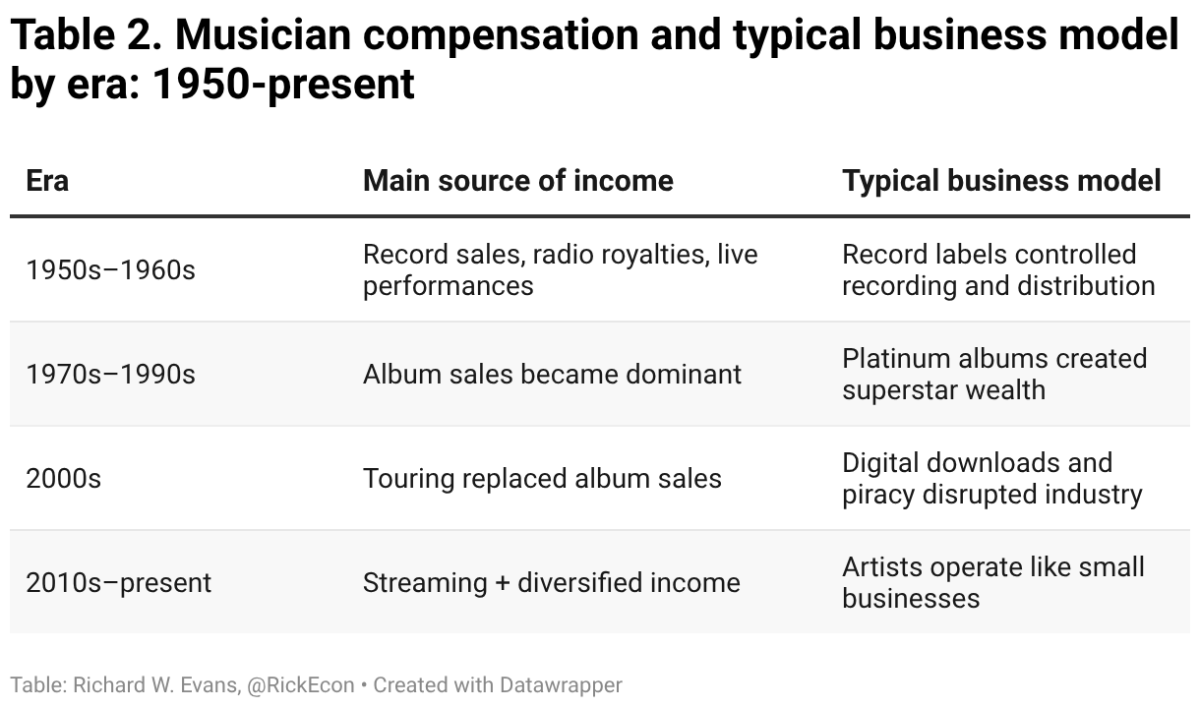
The main trend of the last 75 years is moving the main sources of revenue from radio plays and album sales to streaming and touring revenues. In concert with those changes, the music industry includes more independent artists, and all artists rely more on touring, marketing, merchandising, and customized fan interactions. The successful artists of today operate like businesses.
Some of the characteristics of music and the music industry have improved over the years.
- Recording professional-quality music is far cheaper. Software and digital tools and emulators are better.
- Artists can distribute music globally without a major label. Social media has massively reduced the cost of marketing music.
- Social media allows easier direct fan engagement.
- Independent artists can keep a larger share of their rights and revenues if they self-release.
Other aspects of the music industry have become more challenging.
- Streaming pays much less per listener than record or CD sales did.
- Competition is vastly greater because barriers to entry are lower.
- Marketing has become essential, and musicians often need to create content continuously.
- Income is less predictable and is increasingly concentrated among top performers.
The changes in music compensation described in Table 2 have changed the kind of music that is published and sold.
- Current songs have become shorter. Four- and five-minute songs were common in the 1970s and 1980s. Current songs are rarely more than three minutes. For example, a listener who streams two 2.5-minute songs generates roughly twice as many paid streams as someone listening to one 5-minute song.
- Hooks arrive much earlier in songs today. During the album era, some songs had long introductions, gradual buildups, and extended solos. Because listeners can skip streaming songs instantly, the artists must hook them early.
- Individual songs matter more than albums. Albums of past decades often had thematic unity, narrative progression, experimental tracks, and songs that only made sense in the context of other songs on the album. Today, artists release more singles, EPs, and standalone tracks.
The importance of streaming music rather than radio more quickly exposes listeners to many musical genres simultaneously. For this reason, today’s music regularly blurs the boundaries of musical genres. Taylor Swift moved from country to pop. Coldplay went from independent to pop. The killers went from rock to country. And Jelly Roll, Post Malone, and Beyoncé went from hip hop to country.
With all these trends in current music, AI is further reducing the barriers to creating and marketing music. In the words of Rick Rubin’s June 2025 Daily Stoic podcast prediction, “AI Isn’t Stealing Creativity, It’s Supercharging It.”
4. All creative output is based on training on previous work
Nothing begins with us.
The more we pay attention, the more we begin to realize that all the work we ever do is collaboration.
It’s a collaboration with the art that’s come before you and the art that will come after. It’s also a collaboration with the world you’re living in. With the experiences you’ve had. With the tools you use. With the audience. And with who you are today.
…What’s considered art is simply an agreement. And none of it is true.
What is true is that you are never alone when you’re making art. You are in a constant dialogue with what is and what was, and the closer you can tune in to that discussion, the better you can serve the work before you. (Rick Rubin, The Creative Act: A Way of Being, 2023, pp. 89, 91)
All bands start out as cover bands. And every artist’s original work is based on his or her training on the previous works of the previous artists works he or she has loved and also on the ones he or she has disliked. New works of art being based on previous works of art is not only acceptable, it is universal. It is also true that artists should be able to copyright their work and be paid for its use.
One of the biggest arguments in music and AI today is whether AI music companies like Suno, Udio, and Splice should have to license or otherwise pay the creators of the musical works on which their models were trained. Up to this point litigation brought by major record companies against AI music companies has resulted in licensing payments rather than prohibition and restriction.
In June 2024, the three major record companies Universal Music Group, Sony Music Entertainment, and Warner Music Group filed separate federal lawsuits against AI music generators Suno and Udio. The labels alleged that the companies copied millions of copyrighted recordings to train their models without permission, calling it infringement “on an almost unimaginable scale.” They sought injunctions and statutory damages of up to $150,000 per infringed recording.12
Universal Music Group and Warner Music Group settled with the AI companies in late 2025, deciding on licensing and revenue-sharing for Universal’s music catalogues and the associated artists and songwriters.13 Sony has not yet broadly settled and is applying significant pressure to the AI music companies.14
What seems to be happening in the Universal and Warner settlements is indicative of the likely the direction of a longer run steady-state between the traditional music industry and AI music. The AI companies will have to make some kind of licensing and revenue sharing payments to train their models on the music libraries of the major labels.
This is exactly what we have seen with the larger AI model companies like OpenAI, Anthropic, Google, and X. Owners of textual information content like local newspaper companies are making it difficult for AI companies to crawl and scrape their content without permission. And the AI companies are trying to license unique sources of information from these local newspaper companies. It looks like the record companies will find a price that is acceptable to the AI music companies to license their libraries for AI training. AI music is not going away. It has already changed the music landscape and trajectory.
5. Measure the health of the music industry with dollars and entrants
What is the metric for the health of the music industry? Rubin has an interesting take on success that completely and deliberately ignores what comes after a creative work is published and focuses entirely on the contribution from within the individual.
How shall we measure success?
It isn’t popularity, money, or critical esteem. Success occurs in the privacy of the soul. It comes in the moment you decide to release the work, before exposure to a single opinion. When you’ve done all you can to bring out the work’s greatest potential. When you’re pleased and ready to let go.
Success has nothing to do with variables outside yourself. (Rick Rubin, The Creative Act: A Way of Being, 2023, p. 219)
Rubin’s definition of success, however true it may be of individual wellness and happiness, cannot be the metric for assessing the health of the music industry. This question, “What is the metric for the health of the music industry?” was asked of the music producer Om’Mas Keith in the dinner panel discussion on the first evening of the Summit. And I am not sure that I heard a satisfactory answer from him that night.
One set of measures of the health of the music industry is total dollars spent by consumers on music, total dollars invested by creators and producers, and the total of the two. These aggregate measures neglect questions of the depth and number of artists and works.
One could imagine a world in which one artist produces all the music for the world to consume. It is hard to make the case that one artist is the optimal number, even if the aggregate measures of total expenditure are large from that music. But one could also imagine a world in which creators are heavily subsidized, and every individual has the opportunity to create art. This world would likely result in more creators than is optimal.
Aside from the number of creators, one would expect a healthy music industry to exhibit a large disparity in the quality and popularity across the population of creators. Music quality is subjective, and one can see a large disparity in preferences across music consumers. So rather than a measure of the total number of artists, a good measure of the health of the music industry might include the number of new artists. A healthy industry is one in which new artists can easily enter and try to offer their product to the market.
I propose a measure of music industry health that is a weighted average of two objectives—the annual percent change in total consumption of music industry output and the annual percent change in the number of new artists (suppliers) in the industry.

I propose using the percent change in aggregate consumption and the percent change in new artists because the percent change puts both values in the same units. And the weighted average parameter 𝛼 between 0 and 1 represents the importance of the aggregate consumption measure relative to the new artists measure. In the end, this Music Industry Utility Index gives a number that represents the health of the industry in terms of both total spending and the flow of new artists into the industry.
Conclusion
AI is lowering the barriers to music production, music creation, and writing. It is a tool that can create, enable, enhance, and accelerate the creation, production, and marketing or art. Many musicians today are using AI in their creative process, some publicly and some privately. And there is no sure way to reliably identify if AI was used at all in the production of a creative product.
Despite voices protesting the use of AI in the music industry, a significant number of the true greats among musicians, writers, and producers are using AI to make more music that people want to hear. And rather than reducing the number of artists, AI seems to be enabling increased numbers to join the ranks of the creators.
There are policy debates that need to be resolved in the music industry with regard to AI.
- When is a work of music similar enough to another work of art that it must obtain a license from the other work of art?
- What types of music should be copyrightable, including music produced by AI models?
- How should AI companies compensate musicians for the works on which their models are trained?
- How should we measure whether AI is helping or hurting the music industry?
Similar to general AI models, AI music has already shown its value and is here to stay. The music industry seems to be moving towards an equilibrium in which AI companies have to pay to license the songs on which their models train. And it will be interesting to see how the United States chooses to answer the policy questions above in this age of AI, and how those decisions will influence the music that gets made in the future. For music lovers around the globe, our hopes are for an increase in innovation and output of that musical medium that has the power to move us to joy and tears.
If one wishes to know whether a kingdom is well governed, examine the character of its music. (Paraphrase of Confucius, 551-479 BC, see Legge, 1885)15
Thanks for reading Econosseur! Subscribe for free to receive new posts and support my work.Subscribe
References
Beato, Rick, “Why Paul McCartney Won’t Be On My Channel,” YouTube video (Jul. 17, 2026).
Blanchard, Olivier, X post, Jul. 17, 2026.
Bridgeport Music, Inc. v. Dimension Films, 410 F.3d 792, 6th Cir. (2005).
Campbell v. Acuff-Rose Music, Inc., 510 U.S. 569 (1994).
Chan, Kelvin, “Universal Music and AI song tool Udio settle lawsuit and partner on new platform, sparking backlash,” AP News (Oct. 30, 2025).
Davies, Hugh. “A History of Sampling,” Organised Sound, 1:1, pp. 3-11 (Apr. 1 1996).
Grand Upright Music Ltd. v. Warner Bros. Records Inc., 780 F. Supp. 182, S.D.N.Y. (1991).
Jobs, Steve, Fireside Chat Q&A Session, Apple Worldwide Developers Conference (WWDC), San Jose, California (May 13, 1997).
Lanquist, Edward D. and Benjamin West Janke, “Copyright Law in 2025: Courts begin to draw lines around AI training, piracy, and market harm,” Reuters (Mar. 16, 2026).
Lefsetz, Bob, “The Stones’ New Album,” The Lefsetz Letter: First in Music Analysis (Jul. 12, 2026).
Legge, James, trans. The Li Ki (Book of Rites). Vol. 2 of The Sacred Books of China. Clarendon Press, Oxford, 1885.
Lewis, Jon, “MLB All-Star Game hits high; Derby at low in Netflix debut,” SportsMediaWatch.com (Jul. 16, 2026).
Mcleish, Claire E.A., “Hip-hop sampling aesthetics and the legacy of Grand Upright v. Warner,” Popular Music, 42:1, pp. 79-103 (Feb. 2023).
McLeod, Kembrew and Peter DiCola, Creative License: The Law and Culture of Digital Sampling, Duke University Press (2011).
Netflix, “Fourth Quarter 2025 shareholder letter,” (Jan. 20, 2026).
Padmanabhan, Anjana, “Inside the Copyright Office’s Report, Copyright and Artificial Intelligence, Part 2: Copyrightability,” blog, US Library of Congress (Feb. 6, 2025).
Perlmutter, Shira, “Copyright and Artificial Intelligence Part 1: Digital Replicas,” A Report of the Register of Copyrights, United States Copyright Office (Jul. 31, 2024).
Perlmutter, Shira, “Copyright and Artificial Intelligence Part 2: Copyrightability,” A Report of the Register of Copyrights, United States Copyright Office (Jan. 29, 2025).
RIAA, “Record Companies Bring Landmark Cases for Responsible AI Against Suno and Udio in Boston and New York Federal Courts, Respectively,” Press Statements, Recording Industry Association of America (Jun. 24, 2024).
Rose, Tricia, Black Noise: Rap Music and Black Culture in Contemporary America, Wesleyan University Press (1994).
Roth, Emma, “Here are the 30,000 songs Sony is suing Udio’s AI music generator over,” The Verge (Jul. 20, 2026).
Rubin, Rick, The Creative Act: A Way of Being, Penguin Press (2023).
Schloss, Joseph G., Making Beats: The Art of Sample-Based Hip-Hop, Wesleyan University Press (2014).
Sewell, Amanda, A Typology of Sampling in Hip-Hop, dissertation, Indiana University (May 2013).
Sewell, Amanda, “How Copyright Affected the Musical Style and Critical Reception of Sample-Based Hip-Hop,” Journal of Popular Music Studies, 26:2-3 pp. 295-320 (Jun.-Sep., 2014).
1 As can be seen from my introductory quote and the many quotes of his throughout this article, I was pointed after the Creative Frontiers Summit to Rick Rubin’s 2023 book, The Creative Act: A Way of Being, and deeply influenced by it. He is an eight-time Grammy Award winning music producer and a member of the Rock and Roll Hall of Fame. He is a giant in the music industry. I found his words remarkably applicable to this discussion.
2 See Netflix’s Fourth Quarter 2025 shareholder letter.
3 See Major League Baseball Statistics. Select the 2026 season, sort by home runs (“HR”), and filter by date using the”Split” option selecting “Pre All-Star”. Kyle Schwarber (Philadelphia), Ben Rice (New York Yankees), Junior Caminero (Tampa Bay), and Jordan Walker (St. Louis) participated. The rest of the top 10 home run hitters did not participate.
4 Aside from his Wikipedia page, Olivier Blanchard’s MIT academic page and Peterson Institute policy page are nice references.
5 See Padmanabhan’s February 2025 post on the US Library of Congress blog summarizing the January 29, 2025 US Copyright Office two-part reports on “Copyright and Artificial Intelligence” (mostly Part 2, Perlmutter, 2025 and a small part of Part 1, Perlmutter, 2024).
6 See Perlmutter (2025) for the sources of these Table 1 scenarios and their likely copyrightability.
7 A large number of references give greater detail on the history of musical sampling. See McLeod and DiCola (2011), Schloss (2014), Rose (1994), McLeish (2023), Sewell (2013, 2014), and Davies (1996). Also see the landmark court decisions regarding sampling in Grand Upright Music Ltd. v. Warner Bros. Records Inc. (1991), Campbell v. Acuff-Rose Music, Inc. (1994), and Bridgeport Music, Inc. v. Dimension Films (2005).
8 The artist, Cher, is widely credited as the first artist to use AutoTune on her 1998 hit song, “Believe”. Note that I am one of the people who hates AutoTuned vocals. But I hate it as a matter of personal preference, not perceived objective truth.
9 The Nashville music industry’s separation of writers from musicians is so pronounced that it has given rise to the Bluebird Cafe concerts of writers playing their songs, how they came up with them, and which artists they sold them to. These writers concerts started at the Bluebird Cafe in Nashville and have expanded to a Bluebird Summer Concert Series at the Sundance Ski resort in Utah.
10 Although there is no public accounting of Rick Rubin’s lifetime revenues, one can make a back-of-the-envelope calculation. Producer compensation typically includes (i) upfront production fees, (ii) points (percentage of album revenue), (iii) master recording royalties, (iv) publishing royalties (if producer contributed as songwriter), (v) executive producer fees, and (vi) ownership interests in labels. Rubin has produced or coproduced albums that have collectively sold over 200 million copies worldwide, including projects by Red Hot Chili Peppers, Johnny Cash, Metallica, Beastie Boys, Run DMC, LL Cool J, Adele, Linkin Park, Tom Petty, Weezer, Audioslave, and The Strokes. Adding all the types of revenue up for 200 million albums sold is likely at least $400 million in lifetime earnings.
11 Rick Rubin did a two-part interview on June 25 and 28, 2025 with Ryan Holiday on The Daly Stoic podcast, entitled, “AI Isn’t Stealing Creativity, It’s Supercharging It” (part 1 and part 2).
12 See RIAA (2024) press release.
13 See Chan (2025) for description of Universal Music Group settlement with Udio. See Lanquist and Janke (2026) for a description of the UMG and Warner Music Group settlements.
14 See Roth (2026).
15 This statement is a paraphrase of Confucius (551-479 BC) from the Book of Rites (Liji), from the chapter “Record of Music.” The direct quote from that chapter is, “…the music of a well-governed age is peaceful and joyful; its government is harmonious. The music of an age in disorder is resentful and angry; its government is perverse. The music of a doomed state is sorrowful and melancholy; its people are distressed.” See Legge (1885).