Read this post on Josh’s Substack: Powering Spaceship Earth.
Across the country, a dozen states still maintain statutory restrictions on the construction of new nuclear facilities. These laws, written decades ago, were often driven by fear and misunderstandings rather than practical safety needs. They now function as blanket barriers to innovation—even as nuclear technology evolves and energy needs grow.
Four Types of Nuclear Restrictions to End
The National Conference of State Legislatures provides an overview and tracker detailing the variations in nuclear restrictions. We can sort them into four buckets:
- Outright bans
- Minnesota: Prohibits new nuclear plants altogether.
- New York (Long Island only): A limited regional ban.
- Waste disposal requirements
- California, Connecticut, Illinois, Maine, and Oregon: Require proof of a federally approved technology for high-level waste disposal before construction can begin.
- New Jersey: Requires a state commissioner to certify the safety of waste disposal plans.
- Legislative or voter approval
- Hawaii, Illinois, Massachusetts, Rhode Island, and Vermont: New reactors need explicit legislative approval.
- Maine, Massachusetts, and Oregon: Construction can’t proceed without statewide voter approval.
- Multi-layered hurdles
- Massachusetts: Demands both a popular vote and legislative certification of emergency plans, a permanent and federally licensed waste-disposal facility, decommissioning methods, emission standards, and “optimality” compared to alternatives.
Waste Disposal Mandates Might Backfire
Waste disposal requirements are an alluring but counterproductive approach. This is because mandating long-term storage and disposal ignores opportunities for fuel recycling and reprocessing. Given the increasing interest in advanced nuclear technologies, storing waste may backfire by placing valuable nuclear materials in inaccessible locations, making them difficult to recover.
Additionally, on-site storage is safe and manageable—much more so than the average person realizes. As I testified to House Oversight’s Subcommittee on Economic Growth, Energy Policy, and Regulatory Affairs:
Common concerns about nuclear waste are also overblown. Lawmakers should remember that all energy sources and uses entail some form of waste and byproducts. In the case of nuclear, however, the waste generated by electricity to serve one person during their life would be about the size of a soda can or a coffee cup. In addition, all the existing waste today from U.S. commercial reactors would not even fill a football field.
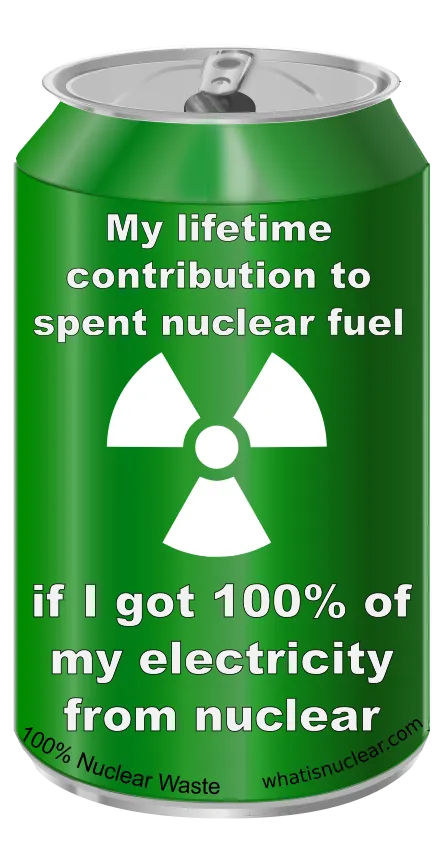
A core problem in nuclear waste discussions is the Nirvana fallacy. That is, nuclear’s problems are treated as if they should be considered in a vacuum without acknowledging the trade-offs that all energy sources require. In contrast to this, remember that nuclear is safe and boring.
Remove Barriers to Energy Abundance
Artificial limits on nuclear energy send a signal that states are closed to innovation. That’s happening at precisely the moment when we need every tool available to meet growing demands. Instead of clinging to outdated moratoria, states should put in place sensible siting, safety, and permitting rules. State leaders can be effective partners to enable a new nuclear future, or they can get in the way.
Far from being impossible, remember that the Idaho National Laboratory is hosting 11 reactors and is on schedule to test several of these by July 4, 2026. Aalo’s groundbreaking ceremony was on August 28, 2025. Utah has announced plans with two nuclear companies and hosted a groundbreaking for one facility in September.
For nuclear to flourish, we will need state leaders to lead the way in making it possible.