Originally published in Tennsight.
When ice storm Fern knocked out power for more than half the state, energy stopped being an abstraction. It is hard to philosophize about the grid when the house is cold and dark. So it is no surprise that the latest Beacon Poll found Tennesseans unusually united on one subject: the power bill is too high, and it keeps climbing. More than three-quarters of voters say their utility costs rose over the past year, and that number holds almost perfectly steady across party lines, at 76% of Republicans and 82% of Democrats. Nearly six in ten are dissatisfied with what they pay. For most households, utilities now eat up more than a tenth of the monthly budget.
The frustration is real, and it is bipartisan. The more interesting question is what Tennessee decides to do with it.
Tennessee already runs on nuclear, and hardly anyone realizes it. Roughly 40% of the state’s electricity comes from nuclear power generated at two plants, Watts Bar and Sequoyah. That is more than coal. More than natural gas. Nuclear has quietly been the single largest source of power in the state for years, and Watts Bar Unit 2 was the first new reactor to come online anywhere in America this century. Yet 51% of voters either did not think Tennessee had any nuclear power generation or were not sure the state had any active nuclear plants at all. In another question, the majority could not guess what share of its power is nuclear. When the correct answer, “40% or more,” appeared as a choice, only 4% of voters picked it. It was the least popular option on the list. Just over half of the respondents were not sure at all.
The obstacle to nuclear power in Tennessee, then, is not opposition. It is unfamiliar. Nuclear is the least polarized energy source in the entire survey. Half of Republicans favor it, more than a third of Democrats do, and when voters are asked the practical question of whether to make it easier to permit and build new plants, support climbs to 54% against just 32% opposed. That is the kind of coalition most issues never get, and it happens to point straight at the real bottleneck: new reactors stall because permitting and decades-old safety rules make them slow and ruinously expensive to build. It’s not public opposition.
The fears that linger are mostly inherited. Asked what shaped their view of nuclear the most, voters split almost evenly between “the need for reliable and affordable energy” and “major accidents such as Chernobyl or Fukushima.” Chernobyl was forty years ago. Fukushima was fifteen. Neither happened in America. A memory from before most of today’s workers were born still carries nearly as much weight as the bill that arrives every month.
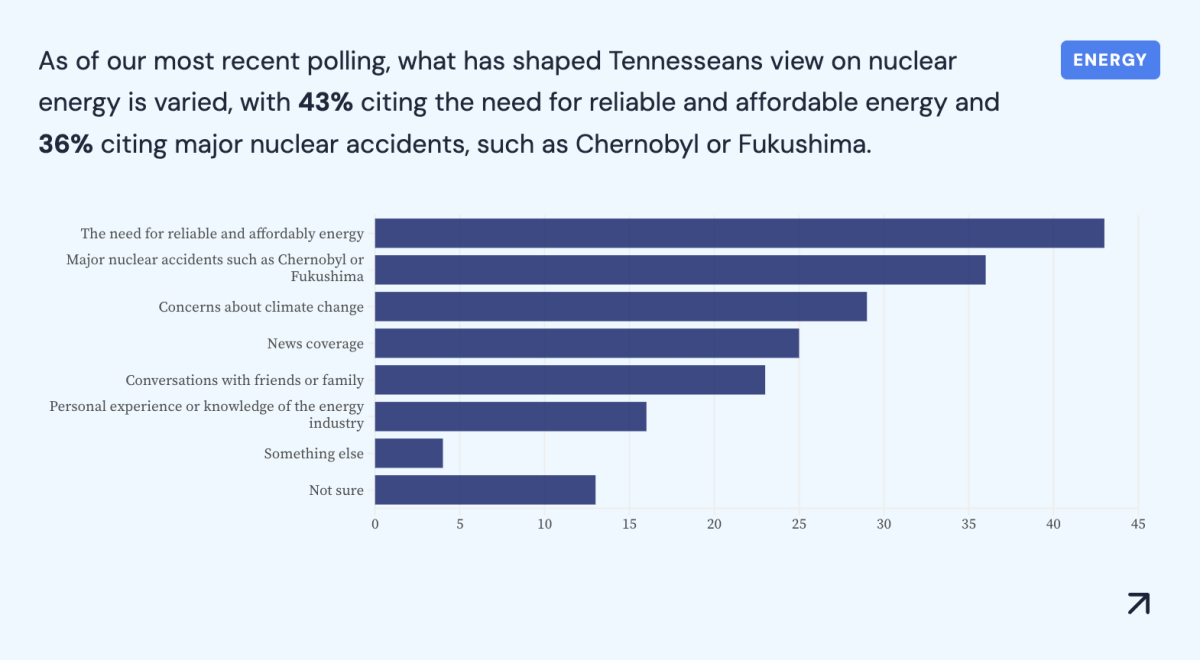
As of our most recent polling, what has shaped Tennesseans view on nuclear energy is varied, with 43% citing the need for reliable and affordable energy and 36% citing major nuclear accidents, such as Chernobyl or Fukushima.
Tennessee is not a bystander in any of this. It is out front and has been ever since scientists discovered how to harness atoms for electricity. TVA recently won a $400 million federal grant to build the nation’s first small modular reactor at Clinch River in Oak Ridge, and signed an agreement for up to six gigawatts of new nuclear, the largest such program in the country. Gov. Bill Lee has led an initiative to revive nuclear power generation in the state, and companies are taking notice. Tennessee’s is not a story of decline. It is a state continuing and improving on a long, rich history of nuclear power ingenuity.
However, leads do not keep themselves, and other states have noticed. For example, Utah Governor Spencer Cox launched “Operation Gigawatt,” a plan to double his state’s energy production within a decade, complete with a nuclear manufacturing hub and tens of millions of state dollars behind it. Governor Josh Shapiro in Pennsylvania initiated a “Lightning Plan” to boost generation and transmission buildout in the Commonwealth. The race is on, and plenty of states want what Tennessee already has.
So the poll describes an opening, not a problem. The frustration is genuine, the opposition to nuclear is soft and largely secondhand, and the asset is already here, humming away in Rhea and Hamilton counties through ice storms and heat waves alike. The work ahead is not to win an argument. It is to clear the way for the quiet workhorse that has powered Tennessee all along, and to build more of it. Abundant, affordable energy is how the cost of everything else finally comes down.