Read this post on Creative Frontiers.
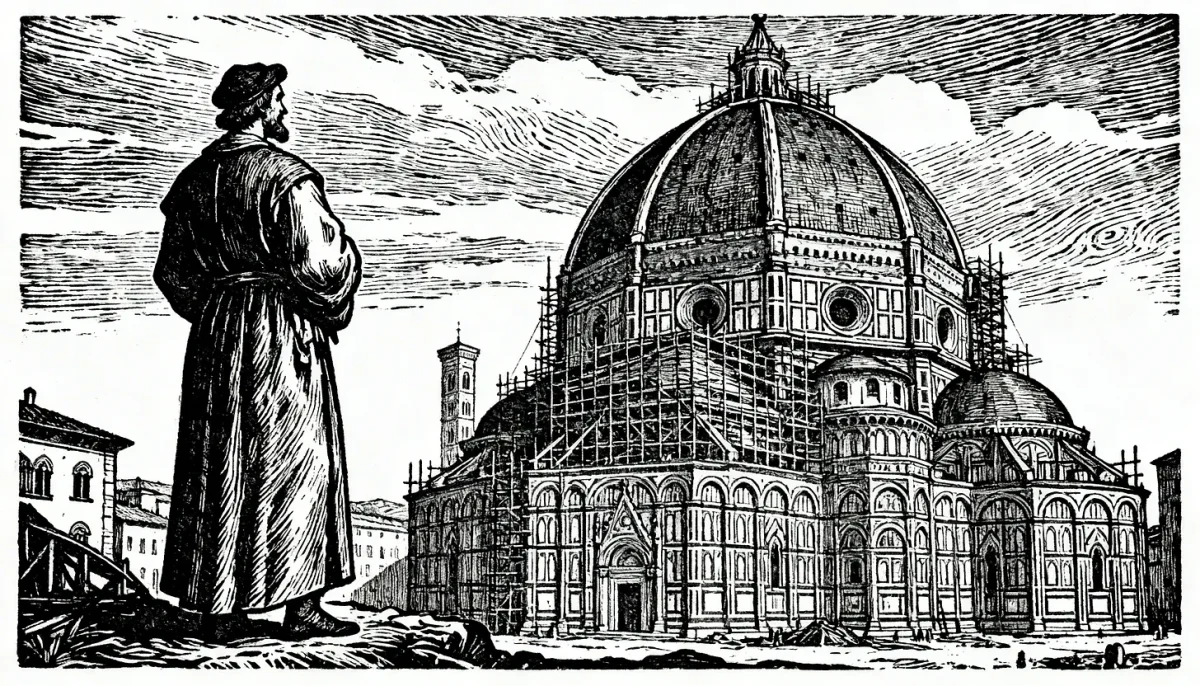
In the 1430s, Florence was less Renaissance masterpiece and more a sprawling, chaotic construction site that smelled of wet lime, mule poop, and the dangerous scent of individuals deciding they could think for themselves. At the center of it all stood Filippo Brunelleschi.
Filippo had an engineer’s mind, an artist’s vision, and a serious problem with authority. He was currently busy designing and building the crown of the city’s Cathedral, the Duomo, a revolutionary dome that required his own bespoke crane system.
But, while the public marveled at the rising skyline, the “experts” were fuming. In 1434, instead of sending a letter of commendation, they sent the brute squad. Brunelleschi, the man literally raising the city’s soul and skyline, found himself in a damp cell, contemplating the reality that disrupting industry didn’t get you a VC check, just a bowl of gruel and a roommate named Rats.
The crime? He refused to share his new ideas with the guilds.
The HOA From Hell
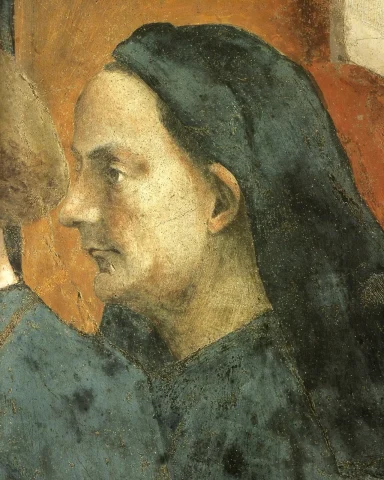
Brunelleschi was a true engineering revolutionary, but he also had a radical, entrepreneurial impulse that defied Florentine dogma. He believed his ideas were just that—his ideas—and that he shouldn’t have to hand them over to the local cartel, the Arte de Maestri di Pietra e Legname, the Stonemasons and Woodworkers guild.
In the 1400s, the guild was straightforward. They owned the craft; you didn’t. If you wanted to work in their trade, membership was mandatory. These were not casual networking clubs. They were the medieval equivalent of an HOA run by the Sopranos. They didn’t just want your dues, they wanted a proprietary lien on your imagination.
Make shoes? Join the Calzolai guild. Carve steaks? Beccai guild. Heal the sick? Speziali guild.
To their credit, these guilds may have ensured your bridge didn’t collapse and your steak wasn’t, well, an alternative meat. But their primary function was “rent seeking,” a fancy term for restricting competition to keep prices up. Practice on your own and you could be fined, lose your shop, or, like Brunelleschi, spend time behind bars.
And guilds not only required membership, they also barred members from sharing trade knowledge with outsiders. This was the 15th century; there were no YouTube tutorials. If you wanted to learn how to practice law or finish cloth, you apprenticed with a master. And if you weren’t in the guild, the masters kept quiet. Loose lips don’t just sink ships; they mangle monopolies.
So, knowledge and skills were communal goods that belonged exclusively to the guild. You didn’t own your ideas.
The irony is that the guilds’ obsession with secrecy revealed just how valuable your know-how could be. When rules violently forbid you from sharing something, you start to wonder, hold up, there must be something to this. Brunelleschi certainly thought so. He believed as the author and the inventor of his techniques and devices, he had a claim to their worth. He had a sense of ownership that feels obvious to us now but was radical and offensive to the gatekeepers of the Renaissance.
A Wooden Middle Finger to the Committee
Fortunately for Brunelleschi, some government officials were questioning those gatekeepers too.
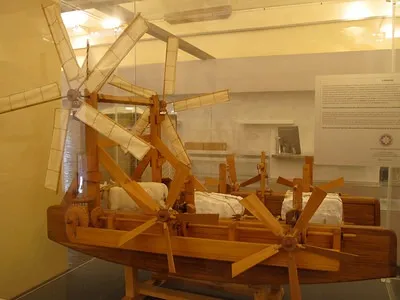
In 1421, a few years before his stint in the clink, Brunelleschi tried something unprecedented. Instead of appealing to a guild, he petitioned the Florentine state for exclusive rights to his boat design. Not just any boat, “The Monster” (Il Badalone). This wasn’t a gondola. It was a marble-hauling beast, and a giant, wooden middle finger to anyone that thought progress was a committee meeting decision.
Brunelleschi argued to the state that protecting his invention from copycats would spur him “to higher pursuits, and would ascend to more subtle investigations.” Give me a pathway to profit, and I’ll invent more really cool stuff.
Florence, hungry for economic growth and concerned about guild-secrecy suppressing new ideas, agreed. They granted Brunelleschi a three-year exclusive right to his “Monster.” And just to show you they were serious, they promised that if anyone built a bootleg version, they would burn it to ashes.
The Brilliant Bargain
Set aside the government-sanctioned arson and the irony of protecting your liberty by destroying someone else’s property, and notice the massive historical pivot.
The Florentine state was experimenting with a radical new concept: granting temporary monopoly privileges to an individual instead of a group.
Now, let’s not get ahead of ourselves. Florence had not declared that “ideas are property.” The republic had simply discovered a pragmatic economic weapon. They realized that granting temporary exclusivity to an innovator could coax knowledge into the open, spurring innovation and progress.
It was a brilliant bargain: You take the risk of inventing something, and we will protect you from copycats so you can cash in. In exchange, your invention operates in the open, and eventually the public gets the blueprints. Florence had stumbled upon an approach that would animate copyright and patent concepts for centuries to come. Reward the inventor, without locking up the invention, and then watch what Matt Ridley calls, ideas having sex.
Brunelleschi’s dome still stands as the largest masonry vault in the world. And his two-shell design is the ancestor of the dome on the U.S. Capitol. It is truly ground-breaking. But his 15th-century bargain with Florence was also an architectural marvel. It was the foundation for a new world of progress built on a radical idea: that the best way to enrich the public isn’t to let a cartel hoard secrets, but to let the individuals own, and ultimately share, their own genius.
Within a few decades, another technology, arriving from a neighboring state and entirely free from the “expert” control of the guilds, would pour gasoline on these embers of transformation..
More on that next time.