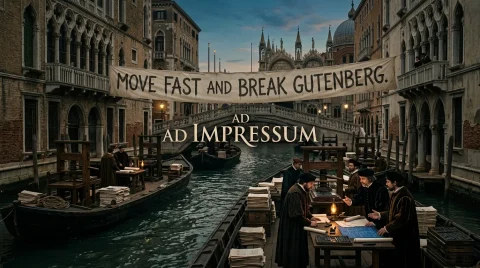
Read this post on Creative Frontiers.
Aldus Manutius was tired of the knockoffs.
Bootleggers were constantly passing off janky, error-riddled editions as his own. They were printing on “foul paper,” that carried an odd funk, and utilizing lettering that, as Aldus bitterly complained, “betray[ed] a certain Frenchiness.”
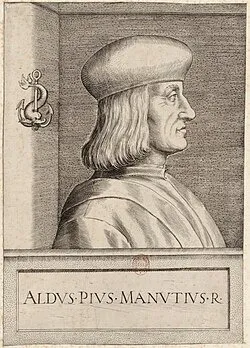
But here is the fascinating part. Aldus wasn’t mad that they were copying his words. He was mad that they were copying his vibe. He was furious that they had stolen his sleek, compact, right-leaning letters.
Bad news for Aldus. Today, we constantly rip off his 1501 text innovation, every time we hit Ctrl+I on a keyboard. We call it Italic.
The Renaissance Kindle
Aldus was the Renaissance equivalent of Gregg Zehr, the Amazon engineer who invented the Kindle. Before Aldus, books were massive, heavy, anchor weights. He was the portability guy. He created pocket-size books. Now, you could toss Virgil in your cloak, or sneak a little Cicero between boring council sessions. He even pitched them as battlefield reading.
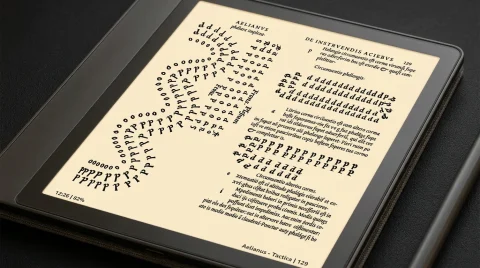
But smaller pages meant fewer words. So, his punchcutter, Francesco Griffo, designed a fresh alphabet, modeled on the slick script used by papal clerks. It was an elegant, right-slanted, and highly compact type. When Aldus rolled it out in 1501, readers ate it up. And immediately, rival copycat bloggers in Venice, Brescia, and Lyon started pumping out cheap look-a-likes.
The Proto-Patent Playbook
So Aldus went to court, Renaissance-style.
He didn’t sue for copyright infringement, because the concept didn’t exist yet. In early print culture, you couldn’t own a story or an idea. But, you could get the state to protect your hardware. What Aldus had was a government “privilege,” a state-granted favor protecting the physical format and style of his books. It was essentially a proto-patent.
This privilege approach went back to the dawn of the printing press. By the 1440s, Johannes Gutenberg was rolling out pages on his wine-inspired device (it was literally a wine press). Two decades later, German printers set up the first press outside of Germany, in Rome.
As we covered in Part 2 of this series, In 1469, Venice had briefly handed a printer named Johannes de Speyer an absolute monopoly on printing. When Speyer died suddenly, the city pivoted, no more blanket monopolies, just case-by-case privileges to lure talent and techniques to town.
16th Century Patent Trolls
As a result, Venice exploded with presses. It quickly became Europe’s hottest print city. But with this boom came a popular, highly annoying new sport: privilege shopping.
It was the 16th-century version of patent trolling. The Venetians wouldn’t organize printing into a closed trade until 1549, so in the meantime, printers and publishers were hungry for any ad-hoc privilege that could protect their product. They would tweak a margin, adjust a woodcut, or change a binding, and then sprint to magistrates shouting, “Innovation!” just to lock down a mini-monopoly.
By 1517, the Venetian Senate was sick of it. With one sweeping decree, they nuked every existing print privilege in the city. Everything already in print fell instantly into the public domain.
Then Venice raised the bar. No more state protection for cosmetic changes. If you wanted a monopoly, the book had to be entirely new.
This sent printers scrambling. They couldn’t just repackage the exact same Latin texts with a slightly different font anymore; they needed fresh material. It was a small policy change with tidal wave repercussions. The focus of the law was broadening from guarding the tools to noticing the text, and importantly, the writers, who then began applying for their own privileges.
Now, let us not get ahead of ourselves, this still wasn’t modern copyright. It was a fragile, fleeting moment. By 1549, the guilds would muscle their way back in, locking authors out of membership and asserting their cartel grip on the industry. But the idea had surfaced, albeit briefly, that the person who creates the work may have a claim separate from the person who owns the tech.
Accidentally Inventing the Author
Which brings us back to Aldus, raging at bad paper and funny letters.
He was navigating a messy, transitional system that rewarded the look of the book rather than the soul of it. When Aldus fought the bootleggers, he thought he was just protecting his proprietary hardware, his beautiful slanted letters.
By fighting so aggressively to protect these formats, Aldus and his rival printers accidentally broke the very system they were trying to exploit. Their endless “privilege shopping” pushed the government to hit the reset button and demand entirely new content. In their scramble to protect it, they accidentally made the machine and its format, secondary.
The printing privilege had always been a hardware right. The idea that the author might own something separate from the format had barely been considered. For a fleeting moment, the spotlight shifted from the guy pulling the press to the guy wielding the quill.
Aldus may be spinning in his grave today as we all bootleg his italics, but he should take comfort. He went to court over a font. He helped invent the author.