Read this post on John’s Substack: Creative Frontiers.
“Nothing can be concealed from these glasses,” the headline proclaimed. A new technology in eyewear was promising incredible capabilities. But privacy advocates were alarmed, and many were bracing for the end of civilization as they knew it.
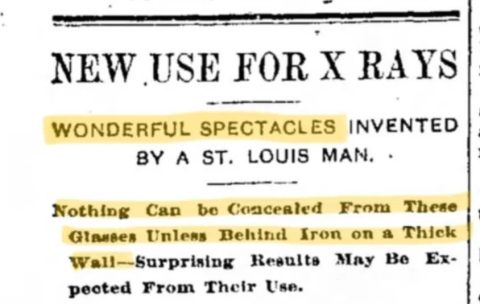
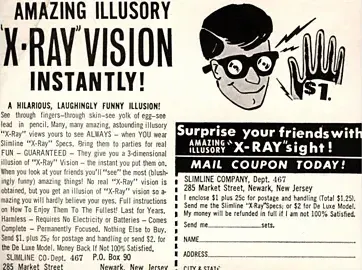
But it wasn’t 2026. And the glasses weren’t Meta’s Ray-Bans. It was 1897, and they were a St. Louis inventor’s “X-ray spectacles” that claimed to see through solid objects. They landed in a moment when folks were already in a state of high anxiety thanks to a genuinely disruptive technology that had arrived just a few years earlier: the portable Kodak camera.
The Kodak had suddenly made anyone a photographer, shattering a sense of privacy that people had always taken for granted. Suddenly, it seemed like cameras were everywhere. But over time, society adjusted and the ubiquity of cameras became normal.
Until today.
Over a century later, the alarm bells are ringing again over invasive lenses. We didn’t ban the cameras then, and we shouldn’t now. And any legislative response demands extreme care, because history shows that when the government tries to save us from technology, it has a way of creating the opposite of what we wanted.
The Privacy Panic
Before 1888, photography required your cooperation. The equipment demanded a professional, a studio, and a subject willing to sit perfectly for five minutes without blinking, breathing, or smiling. Then George Eastman, a former bank clerk from Rochester, N.Y., handed a wooden box to anyone with $25. His Kodak No. 1 camera came pre-loaded with 100 exposures and a promise on every advertisement: You press the button, we do the rest.
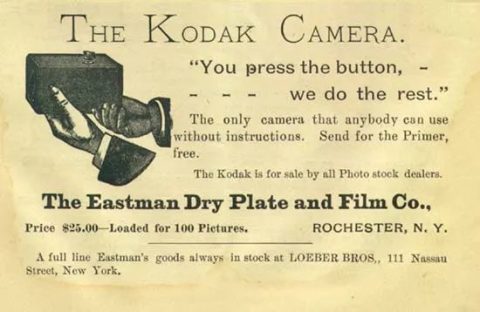
Suddenly, anyone could be a photographer, and a new social menace materialized on boardwalks and public streets: the “Kodak fiend.”
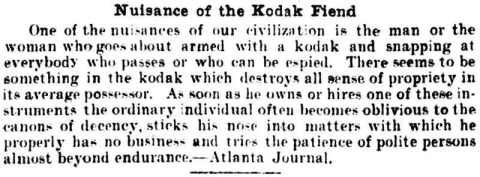
These supposed “deviants” were simply everyday people eagerly snapping photos, which often included unsuspecting subjects. Encouraging this craze were newspaper editors, who began paying double for candid celebrity shots, along with advertising agencies who began including images into promotions. Overnight, no one was safe from being captured and plastered across town.
The lawsuits followed. An opera star sought an injunction after advertisers circulated a candid photo of her in tights. A widow went to court to stop a cigar brand from using her late husband’s face. A physician sued over a throat tonic that borrowed his endorsement without asking.
But the law wasn’t prepared to respond. The courts were still living in Benjamin Franklin’s era, when a famous face was civic property and nobody sued over a dinner plate bearing their likeness.
So, one aggrieved lawyer proposed a new solution.
Samuel Warren had married into a high-society media circus and was exhausted by the uninvited cameras ruining his dinner parties. Enlisting a future Supreme Court justice, Louis Brandeis, they published “The Right to Privacy” in the Harvard Law Review in 1890.
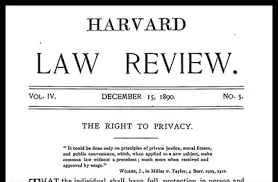
In one of the most consequential legal articles ever written, they constructed a framework to address this novel harm: not theft, not defamation, but an injury to the private self, to what they called the “inviolate personality.”
But over time, people grew accustomed to the cameras, the law shifted, and the panic passed.
The Return of the Lens
As it turned out, the Kodak fiend didn’t ruin society, as some had feared. He just became most of us, casually documenting our lunches, our children, our sunsets, and the occasional unsuspecting stranger. In fact, today more than two trillion photographs are taken in a single year, roughly 1.8 trillion of which are our cats sleeping. And we do it all with a device more powerful and inconspicuous than anyone in the 1890s could have ever imagined.
But something has people smashing cameras again. Not the ubiquitous iPhones or Ring doorbells. Instead, activists are targeting solar-powered boxes made by an Atlanta company called Flock Safety. These devices have been spray-painted, taped over, and destroyed. Congress is even considering cutting federal funding to agencies that use them.
And they aren’t the only cameras under siege.
Meta’s smart glasses are receiving similar attention. Critics have dubbed them “pervert glasses,” while Senators have written sternly worded letters to Mark Zuckerberg, and more than seventy-five civil liberties organizations have signed warnings. An activist group called, “Everyone Hates Elon” even posted protest posters over Meta’s Kylie Jenner ads for the new spectacles, which feels like mission creep, considering Elon Musk has nothing to do with them.
It sounds a lot like the 1890s. A new camera has raised the stakes on privacy. Now, someone can record you without the universal warning sign to which we have grown accustomed: a person holding a glowing rectangle directly in front of their face. Though, if we’re honest, with modern zoom capabilities, someone could be filming your nostrils right now, and you wound’t know it.
Regardless, we can take comfort in knowing that existing harassment and voyeurism laws still apply. And, as before, society will develop the necessary norms and etiquette to manage the threat.
However, there is something new stoking the modern outrage. With Flock and Meta, it’s not just the camera; it’s what the camera feeds.
It’s More Than a Camera
In October 2024, Kashif Hoda was waiting for a train at Harvard Square when a young man in thick-framed glasses asked him for directions. A few minutes later, the same guy approached again. “Do you happen to be the person working on minority stuff for Muslims in India?,” he asked.
Hoda was surprised. How did a complete stranger know that?
The young man was AnhPhu Nguyen, a Harvard junior. He and his classmate, Caine Ardayfio, had developed a system they called “I-XRAY.” It fed images from the Meta glasses into a public facial recognition service PimEyes, and then ran the results through a large language model to excavate personal information.
They had basically built a working version of the X-ray glasses the newspaper warned about in 1897. Sure, they couldn’t see through a person’s clothes, but they could certainly see through their anonymity.
These glasses, like today’s Flock cameras and Meta smart glasses, feed an instant identification system that obliterates the old norms of public privacy. Flock cameras don’t just capture a passing moment; they build permanent dossiers by reading license plates, tagging timestamps, and uploading everything to a massive, searchable national database. Similarly, recent reports that Meta has quietly embedded unreleased facial-recognition code, known as NameTag, into its smart glasses app supercharges what these lenses can do.
But banning the hardware misses the point. As Nguyen pointed out to Forbes, the glasses themselves are almost irrelevant. “This could be done with any regular phone camera and still do the same amount of damage,” he explained.
The Legal Mutation
When confronted with a new, alarming technology, our instinct is often to ban the tool. But outlawing smart glasses would be a mistake. It risks sacrificing a technology that holds the promise of immense human benefit, from real-time language translation and life-changing accessibility for the visually and cognitively impaired.
Furthermore, top-down regulatory “fixes” have a notorious history of missing the actual target and creating unintended consequences.
Consider Warren and Brandeis. In 1890, their instinct was to build a legal shield to protect human dignity from cameras. They wanted to keep your likeness out of the marketplace.
But as that grand intention ground its way through the gears of the legal system, it mutated into precisely the opposite. It became the modern “right of publicity,” which explicitly treats your face as a commercial asset to be bought, licensed, and sold to the highest bidder. By the time the ELVIS Act passed in Tennessee, the legislation bearing the spirit of Warren and Brandeis wasn’t protecting Elvis’ privacy and dignity. It was protecting the bank account of whoever held the licensing rights to his “inviolate personality.”
They aimed at the right thing, and still ended up somewhere they never intended.
The Student Solution
That’s the regulatory trap we face today. If lawmakers rush to ban the frames, they will stifle the benefits that the technology can provide, all while aiming at the wrong target. It’s not the glasses that threaten our privacy norms, it’s the underlying infrastructure, which can be hooked up to any camera on earth.
Instead of looking to Warren and Brandeis for a top-down legal fix, we should look to those two Harvard students.
They built I-XRAY to raise awareness, pairing it with a comprehensive guide to equip everyday folks on how to opt-out and remove themselves from the databases that made the system possible.
They understood that the camera is already out of the box. Their solution was bottom-up: raising awareness, equipping users with technological self-defense, and helping society develop new norms for a new frontier.
That might not be a complete answer. But it’s the right kind of answer.