Read this post on Josh’s Substack: Powering Spaceship Earth.
On Tuesday, July 22, I testified for the House Oversight Committee’s Economic Growth, Energy Policy, and Regulatory Affairs on nuclear policy. Below is my opening statement and a link to the video. More to come on this soon.
Chairman Burlison, Ranking Member Frost, and Members of the Committee, thank you for the opportunity to testify. My name is Josh T. Smith, and I am the Energy Policy Lead for the Abundance Institute. We are a mission-driven nonprofit dedicated to creating the cultural and policy environment necessary for emerging technologies to thrive and drive widespread human prosperity.
My three core points to you today are:
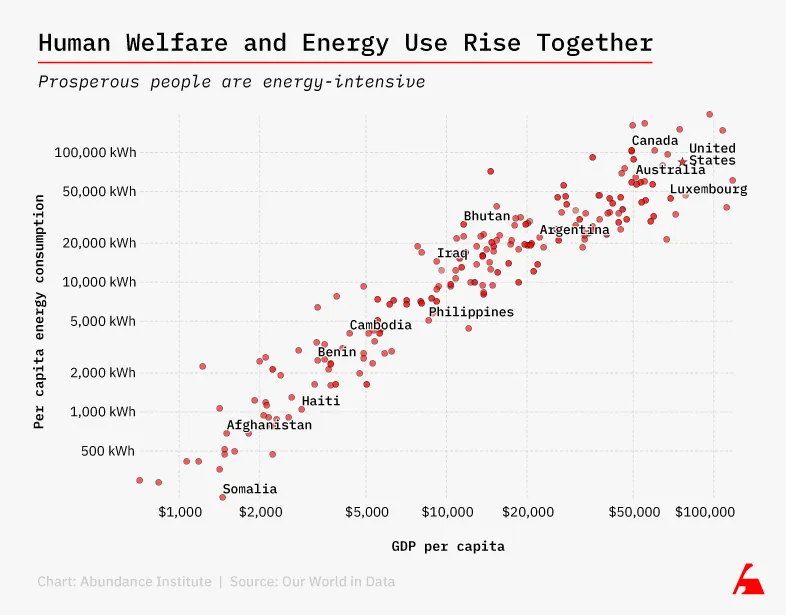
- Prosperity is energy-intensive.
- Regulatory failures hold back the nuclear industry.
- State policymakers are anxious to play a role in America’s new atomic age.
Prosperity is energy-intensive
America’s economic growth, technological progress, and improved quality of life all require more energy, not less. A world of energy abundance is a world of opportunity: for industry, for families, for national strength. Since the first reactors lit up, nuclear power has played a role in this story. But it has yet to reach its full potential.
Regulatory failures hold back the nuclear industry
Every discussion of nuclear’s future should start with a simple historical fact: For decades, American engineers built nuclear plants swiftly, safely, and cheaply.
Connecticut Yankee, in 1968, was built for about $1 billion in today’s terms and in about five years. This trio—swift, safe, and cheap—was the norm.
Nuclear’s struggles today aren’t inherent to the technology. They are the product of outdated, unfit, and counterproductive regulations.
Major barriers include:
- ALARA & LNT Standards: These impose costs without offsetting safety benefits.
- Inflexible NRC Frameworks Prevent Innovation: Previous reforms meant to streamline regulation for small modular and advanced reactors have yet to yield new deployed reactors.
- Nuclear’s Risks are Widely Misunderstood:
- For example, there were no radiation-caused deaths from Three Mile Island.
- Chernobyl’s disaster is impossible in modern reactors.
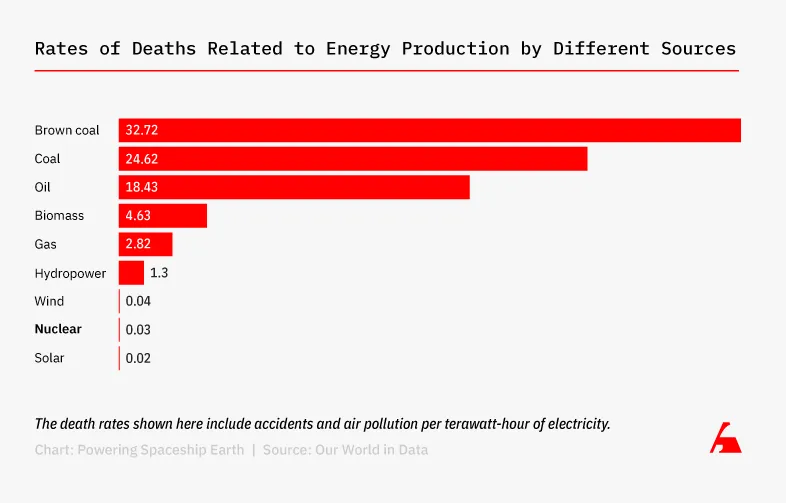
- Measured in deaths per terawatt-hour, nuclear is 800x safer than coal and nearly 100x safer than gas.
- Nuclear Waste Fears Are Overblown: A person’s lifetime nuclear waste is about the size of a coffee cup. All U.S. commercial nuclear waste could fit on a football field, less than 10 yards deep, and much could be recycled.
Policymakers should also not forget the interconnected nature of electricity policy challenges. Even with NRC reform, nuclear projects will be bogged down in the same transmission, interconnection, and permitting bottlenecks that stifle all large-scale infrastructure. For example, it takes, on average, 10 years to build a transmission line, yet 7 of those years are paperwork and only 3 are construction. Interconnection timelines also add years of delay.
Consider that Governor Josh Shapiro personally requested that the PJM grid operators expedite the reconnection of the Three Mile Island reactor. There is indisputable merit in the restart. Yet, “only in broken systems does a project require a governor’s intervention to move forward.”
Free entry into the energy system is fundamentally broken. Nuclear entrepreneurs can’t succeed in a system that blocks entry before shovels hit dirt. Licensing, permitting, and interconnection are all clogged arteries in need of reform alongside nuclear regulations.
The core lesson is that we need to streamline permitting and grid interconnection to enable nuclear and ensure an affordable and reliable energy supply.
States Are Ready for a New Atomic Age
In the past, governors and lawmakers played gatekeepers almost universally for ill. For example, Senator Harry Reid’s opposition to storing waste at Yucca Mountain set the tone for today’s conversations. Massachusetts Governor Michael Dukakis opposed the start of the Seabrook plant in neighboring New Hampshire, adding at least three years of delay to the project.
Today, governors and state legislators are leading the opposite charge–pushing to enable nuclear power in their states. Over 250 nuclear-related bills were introduced in state legislatures in the last two years. States are collaborating on nuclear development.
Leaders in Utah, my home, including Governor Spencer Cox and members of the state legislature, work every day to attract and promote nuclear development.
Safe, swift, and cheap nuclear is possible with simple regulatory reform
Ushering in the new atomic age requires tackling the misperceptions about nuclear power and fixing its failing regulatory system. Returning to a world where nuclear power is swift, safe, and cheap is not just entirely possible, it’s recent American history.
Fixing these problems will lower energy costs for your constituents, promote a reliable electricity grid, and drive continued improvements in human welfare.
Thank you.