Read this post on Creative Frontiers.
On a muggy day in June 1906, John Philip Sousa walked into a hearing room on Capitol Hill, took his seat at the witness table, and prepared to save American music from itself. Or perhaps just to enrich his bank account.
Sousa had every reason to be confident. He was fifty-two, the composer of “The Stars and Stripes Forever,” and the owner of a mustache that could safely harbor a family of songbirds through a harsh winter. The committee leaned forward, eager to hear from the most famous bandleader in the world, as the air filled with the smell of pipe smoke and the damp wool of senators in a sweltering summer.
Sousa told them that the country was facing an emergency. The player piano and the phonograph were producing a generation of passive consumers who would no longer sing, no longer play, no longer gather around the parlor piano on Sunday evenings. The human vocal cord, he warned, would atrophy. Amateur musicians would vanish, and take their teachers with them.
Three months later he would publish a version of this argument in Appleton’s Magazine, under the title, “The Menace of Mechanical Music.”
It was a moving performance, and it was also a masterpiece in lobbying.
Because by the time Sousa sat before Congress in 1906 to warn of these machines, he had been recording his marches on them with Columbia, Berliner, and Victor for sixteen years. He was hardly the luddite, smashing these infernal devices that threatened all he held dear. Instead, he had embraced them.
Perhaps, Sousa’s Congressional quest wasn’t actually about a cease and desist as much as it was about getting a piece of the action.
The Performance
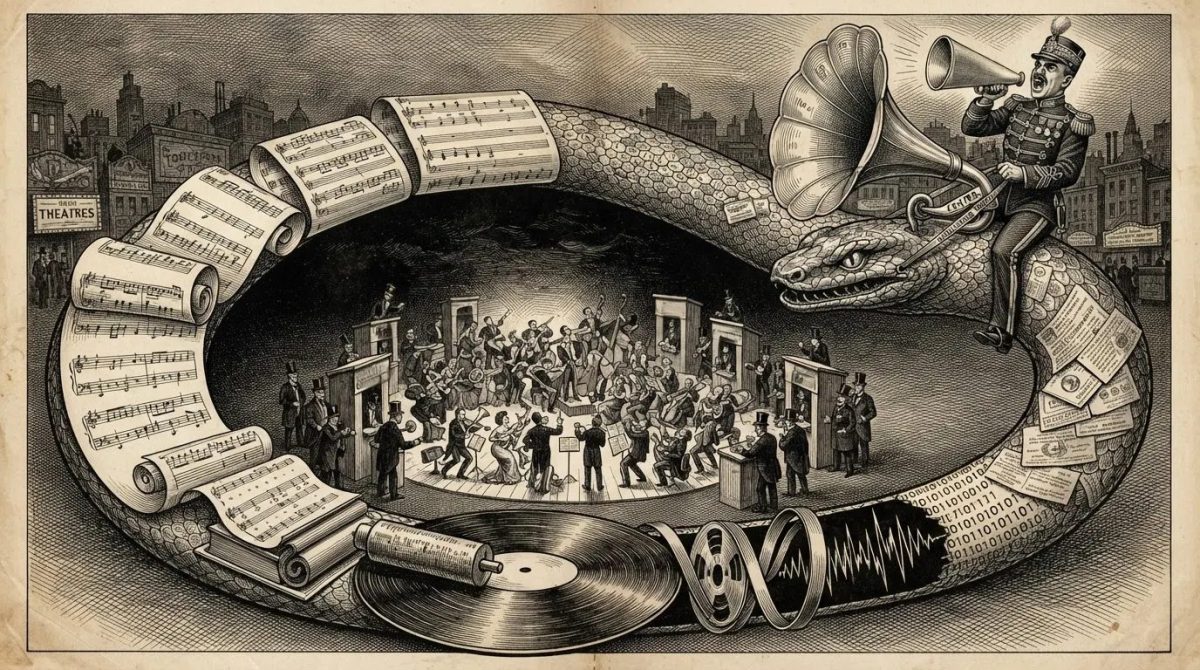
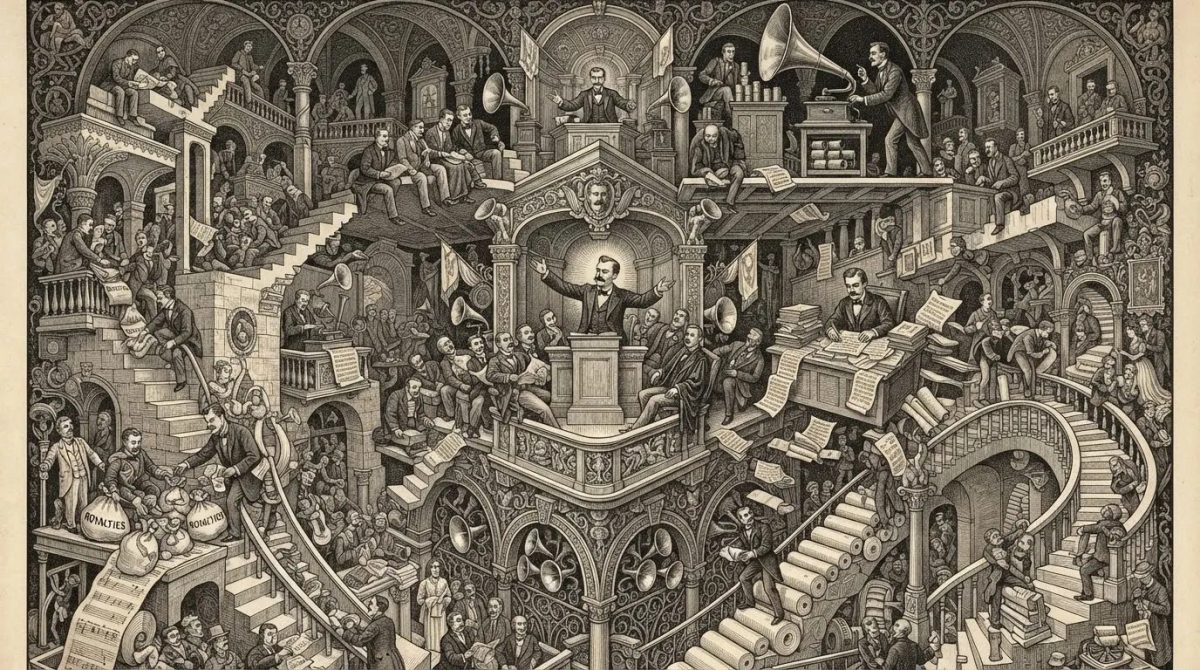
The Appleton’s article, when it ran that September, was ten pages long and adorned with clever cartoons. Throughout it, Sousa explained that mechanical reproduction would “reduce the expression of music to a mathematical system of megaphones, wheels, cogs, disks, cylinders, and all manner of revolving things….” Phonographs would usher children to sleep instead of their mother’s songs. Romantics would serenade their lovers with recordings. The parlor piano, a nineteenth century ideal of family togetherness, would fall silent. Like the English sparrow, he warned, these machines would appear innocent but reap “destruction.”
While it was a passionate and persuasive argument, it was wrong. Census data from 1890 to 1910 reveals the number of music teachers actually increased per capita during these years. It seems more people wanted to participate in music, not fewer. So, the mustachioed prophet wasn’t right, but perhaps he wasn’t actually a believer himself. Perhaps he had other intentions behind the pitch.
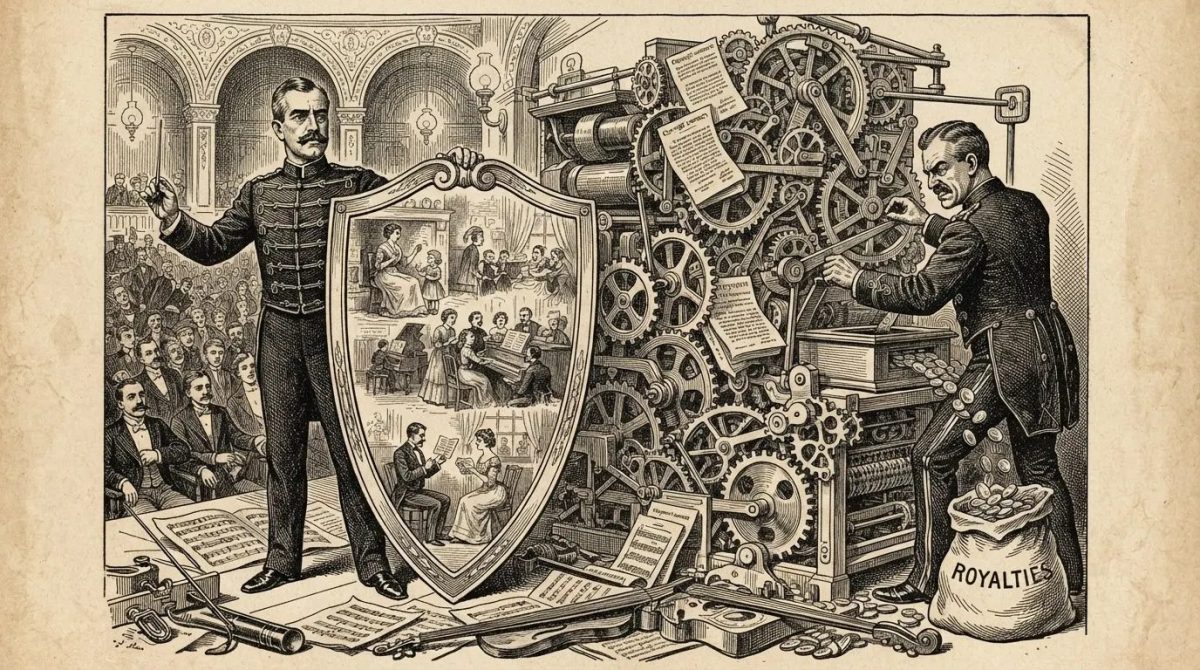
American copyright law in 1906 did not recognize a composer’s right of ownership when their work was reproduced mechanically, only when it was printed on paper. So, while Sousa’s songs were being pressed onto cylinders and piano rolls across the country, he wasn’t reaping the financial rewards. He wanted to change that, to change copyright. But he had learned, through earlier lobbying efforts alongside music publishers in Europe, that nobody would rally around his financial woes. People would, however, rally around a moral cause.
So, he crafted his arguments about the existential threat these new technologies posed to musical culture in America and went before Congress multiple times. He arose as a champion of the new Copyright Act, which passed in 1909 and created the first compulsory mechanical license: two cents per copy to the rights owner.
The Moral Shield
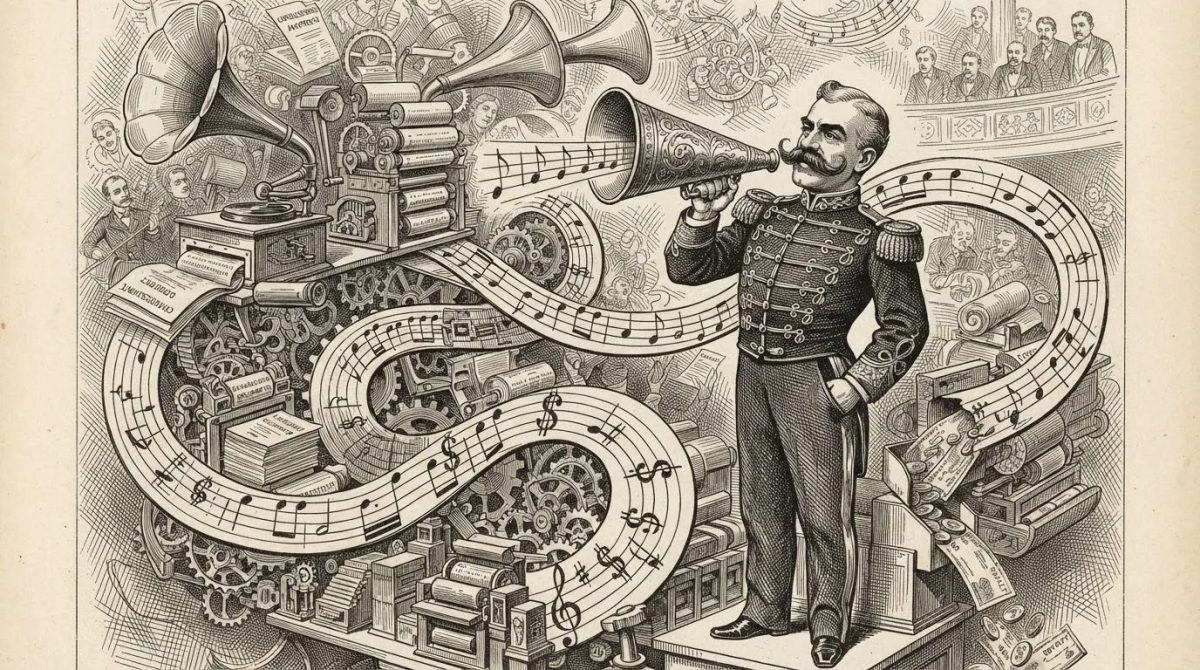
Sousa was not alone in this strategy. Throughout history, when a new technology threatens an existing creative economy, the folks most threatened rarely say “my wallet is at stake.” They say, “the soul of the art form is at stake.” They take up the moral argument as a shield to protect their financial interests. Certainly it’s not entirely a ruse. Sousa did love music and had reasonable concerns. As I explored in an earlier essay, Filippo de Strata, the 15th century scribe who begged Venice to ban the printing press, probably did truly worry about the effects on kids. The concern isn’t wholly manufactured, but it is strategically deployed.
So, how can we know the real motives behind the shield? Perhaps the revealing question is, what solution would they accept?
Sousa didn’t actually want mechanical music banned. What he accepted was a pay day, a royalty. Once the money followed his music, the civilizational crisis quietly faded away. That says a lot about where his concerns really lived.
Same Argument, New Machine
In the summer of 2024, the major record labels, Universal Music Group, Sony, and Warner filed coordinated lawsuits against AI music companies Suno and Udio. The legal argument was that training on copyrighted recordings without a license constituted infringement. The moral framing, however, was far more apocalyptic: AI threatens working artists and undermines the soul of creativity.
Some of that moral shield is undoubtedly sincere. But the diagnostic question is the one Sousa’s career answers. What solution would the labels accept?
The early signs are not “shut the technology down” to protect human artistry. Instead, it’s a partnership. The labels have moved from litigation to licensing deals with the companies they sued. They want an architecture that routes AI music through their existing industry infrastructure. That sounds more like continued control over artists than it does compensation and justice for artists.
Sousa certainly got compensated. He went on to cash big checks from his compositions, performances, and recording. He toured the world with his band until the end. And when he died in 1932, the morning after conducting a rehearsal (which is the way to go), he was one of the wealthiest musicians in America. And the music that he had warned would be eviscerated by the mechanical armies played on without him, while his descendants got paid.
So, the next time you meet the ghost of Sousa in a story or a social media post, warning that a new technology is the menace of music, it’s worth asking the question that Sousa’s story answers:
What solution would they accept?
Sousa’s ghost knows the answer. He’ll quote you a rate.
That may tell you more than the argument.