Read this post on Josh’s Substack: Powering Spaceship Earth.
“It ain’t what you don’t know that gets you into trouble. It’s what you know for sure that just ain’t so,” is often mistakenly attributed to Mark Twain. There’s an inherent irony in its misuse by moralizers (myself included!). Confidently held misconceptions steer us into serious trouble. Two such myths around electricity policy matter because they send us in the wrong direction at the wrong problems to solve.
Myth: Electricity prices in Texas and the US have skyrocketed
As shown in the chart, nominal electricity prices in Texas have significantly increased. This perception neglects a critical factor: inflation. When adjusted for inflation, electricity prices today are not significantly different from those a decade ago.
Inflation is a serious economic concern, effectively stealing the savings of Texans and Americans daily. However, attributing these rising costs to changes in Texas’s electricity mix—particularly blaming renewables—is simply incorrect. If you examine the real prices line for Texas, you can see a dramatic reduction in electricity prices since around 2008. This is largely a benefit from fracking enabling cheaper natural gas. So, renewables boosters should be careful not to claim more credit than they deserve. Research indicates that solar has also brought lower net costs to Texans.
It’s also worth complaining that electricity prices have not declined over the last 30 years! Even though generation costs have dropped significantly, customers are stuck paying for the wires system. Distribution costs and transmission costs now account for the majority of your bill because of falling generation costs. Fundamentally, there’s work to do here until electricity is too cheap to meter! Yet, there is clearly room for improvement in the distribution of electricity as well.
Inflation demands serious economic policy reforms. Imprudent government spending within energy policy certainly contributes to inflation. Fixes in this area are vital. Yet misdiagnosing it as solely a result of energy policy leads us down the wrong policy path by ignoring the growing importance of distribution costs.
Myth: Renewables caused Texas’s 2021 Winter Storm Uri disaster
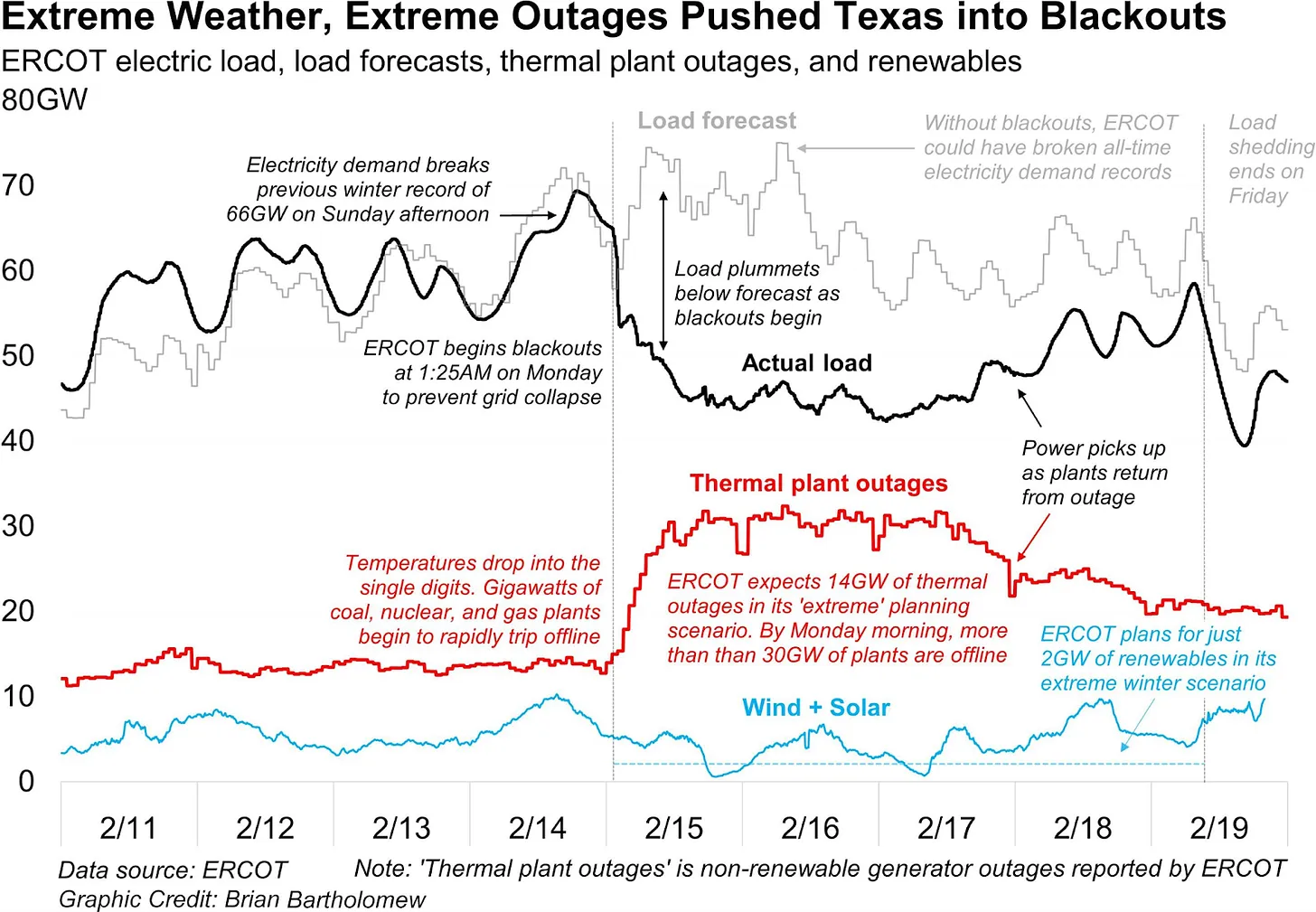
Another widespread misconception is that renewables were responsible for the catastrophic blackouts during Winter Storm Uri in 2021. The reality is quite different. The primary failures during Uri were within the natural gas system, compounded by inadequate political oversight and a lack of enforced safeguards.
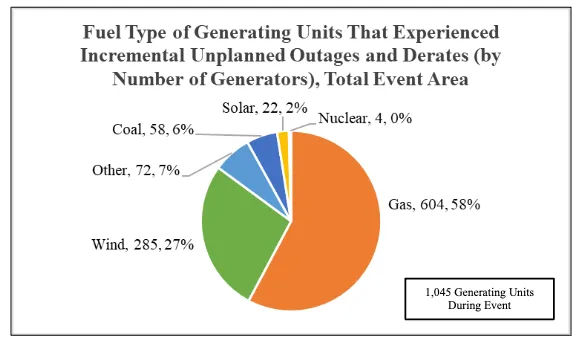
The primary culprit for the electricity system failure was problems in electricity production from natural gas. About 40% of natural gas production was not available during the crisis. Texas’ gas, electricity, and water systems are inter-linked so failures in one of them can lead to cascading effects on the others.
There is more than enough blame to go around, as I’ve written about before. Essentially every source failed, as you can see in the table. Solar is the only overperforming generator, but it wasn’t close to enough to keep the lights on.
Part of the reason it overperformed is that it was expected to produce 0.3 gigawatts and actually produced almost 0.8 gigawatts. For comparison, thermal outages were around 30 gigawatts. ERCOT expects just 14 gigawatts of thermal outages in extreme situations. Some of solar’s success shown in the table comes from the obvious fact that lower hurdles are easier to clear. That said, more solar would have made Uri easier to deal with.
Misattributing the failure in Uri distracts from the necessary improvements in infrastructure and political governance required to prevent future disasters.
I am the easiest person to fool
The commonality of Twain’s misattribution is useful because it reminds us to be cautious about our own confidently held falsehoods. Richard Feynman was right when he told Caltech students in 1974:
The first principle is that you must not fool yourself—and you are the easiest person to fool. So you have to be very careful about that. After you’ve not fooled yourself, it’s easy not to fool other scientists. You just have to be honest in a conventional way after that.
The world is full of poor policy choices that you and I pay dearly for every day. Misdiagnosing our energy problems, either by ignoring inflation or blaming renewables for blackouts, will only make those poor choices even more expensive. Better policy begins by correctly identifying the wheat from the tares, then pulling up the weeds at the roots.