Read this post on Josh’s Substack: Powering Spaceship Earth.
Each year, Potomac Economics releases a detailed analysis of competition, prices, and what happened in the Electricity Reliability Council of Texas (ERCOT) market. There’s a lot to unpack, but this chart displays an incredible price reduction over the last year. Average wholesale prices fell from an average of $70 per MWh in 2023 to $34 per MWh in 2024.

Potomac Economics attributes this ~50% price reduction to two factors. First, reduced natural gas prices. And, second, more suppliers in the market. Two key takeaways from these falling prices warrant closer examination. These price reductions are welcome news, but they can be easily misinterpreted.
Two limits and implications
First, this 52% drop in wholesale prices doesn’t mean your electricity bill was cut in half. Why not? This price reduction applies only to the electricity portion of bills—generation. The full bill you pay each month reflects the costs of generation, transmission, and distribution. As generation costs fall, the other portions of your bill become larger shares. The result: Pricier wires carrying cheaper electricity.
For what it’s worth, electricity rates in Texas haven’t changed much in real terms since 1995. The policy implication is that focusing solely on changes in generation sources is insufficient to drive down bills. Stagnant electricity rates, in real terms, are better than increasing prices, sure. But not as good as falling bills and total costs.
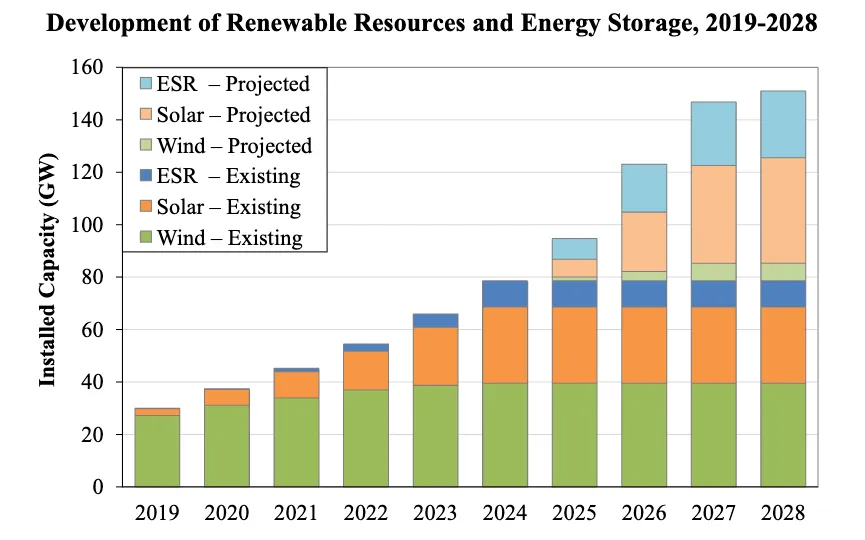
The second interesting point stems from the reality that solar all comes online at once. When it’s sunny, the solar plants output healthy amounts of electricity. The report illustrates how solar and storage have come online in force since 2018 (yellow and dark purple in the chart below). In just 2024, 7.5 gigawatts (GW) of solar capacity and 5 GW of energy storage capacity.

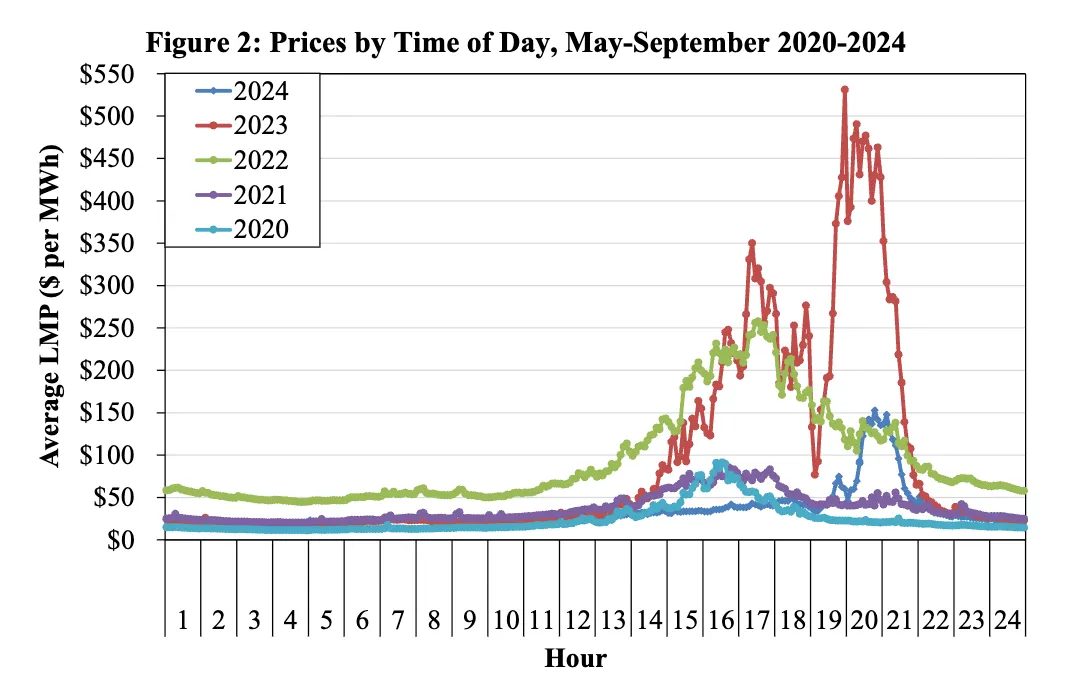
Storage is going to become more and more common. That’s one of the takeaways from our report on solar economics. You can see why in the following chart showing prices by time of day. Since solar comes online at the same time, it floods the market and then disappears. Storage moves some of that electricity in time, which mitigates the glut from solar when it’s not needed or wanted. As the last five years of Texas’ electricity prices depict, the timing of pricey moments on the grid is changing. Instead of mid-day price spikes, the highest prices happen when solar electricity falls off with the sunset.
It’s also worth emphasizing that supply is also on its way, just as demand is growing. This is a foundational element that is lost in the panic about demand growth in Texas (and the country). According to the Potomac Economics report, 40 GW of solar and 25 GW of storage “have already signed interconnection agreements for installation by 2028.” Across the interconnection queues for the country, there is plenty of generation waiting to plug in.
A constantly moving target
What you see in price fluctuation is a giant and constantly moving target. The evolution from 2023 to 2024 is a testament to the combined influence of solar, storage, reduced gas prices, and weather conditions. It reflects that the role of entrepreneurs is chasing a constantly moving target.
There’s an old joke: if you spend $0 on electricity for 23 hours of the day and $5,000 in just one hour, were those other 23 hours really free? It’s meant to poke fun at pricing dynamics. Specifically, its point is that cheap solar power during some parts of the day doesn’t necessarily lower overall costs. And while it’s fair (even valuable!) on the surface, it misses a truth about how price signals work. The joke reveals economic ignorance derived from the static blackboard models of economics.1
Blackboard models display tidy solutions. That means they wipe out the churn of the market process. Markets evolve with technology and innovation. There’s trial and error, experimentation, and occasional missteps by entrepreneurs and regulators alike.
In a world with volatile electricity demand and generation, there will be hours with very high prices. The question becomes: how do energy entrepreneurs respond to those moments? If you look back at the ERCOT chart of recent capacity additions, there’s more than just solar and batteries coming online. Additional gas peakers entered the market to cover those shrinking but still expensive peak hours.
The ERCOT market report tells the story of a system trying to balance that experimentation with reliability. Engineers and grid operators work diligently behind the scenes to maintain grid stability while making room for innovation.
On its ability to promote innovation and clear a runway for entrepreneurs, the Texas model is one that more people should emulate. It’s a design that has driven down electricity generation costs. The moving target should be shifting towards the wires.
[1] A useful couplet that deserves a footnote here and full treatment another time. Yes, electricity has special characteristics. No, that does not mean economics doesn’t apply to electricity. Electricity’s status as the ultimate in-time good does not exempt it from the logic of economics.